Summary
- Navigating federal DOT compliance amid state-level legalization to understand the zero-tolerance policy and its impact on hiring and retention.
- How CBD products and DOT-mandated drug testing can inadvertently disqualify drivers.
- Leveraging technology, education programs, and alternative testing methods to improve compliance to protect your fleet and retain drivers.
Welcome everyone.
Thank you for joining us for today’s webinar.
My name is Emily Cash with the Freight Wave Media Team,
and I’m happy to present this webinar in partnership
with Fleet Worthy Today we’ll explore the challenges
and opportunities fleets face in navigating cannabis
regulations, compliance and driver retention,
and an evolving legal landscape.
I’m happy to be joined by fleet worthy compliant experts,
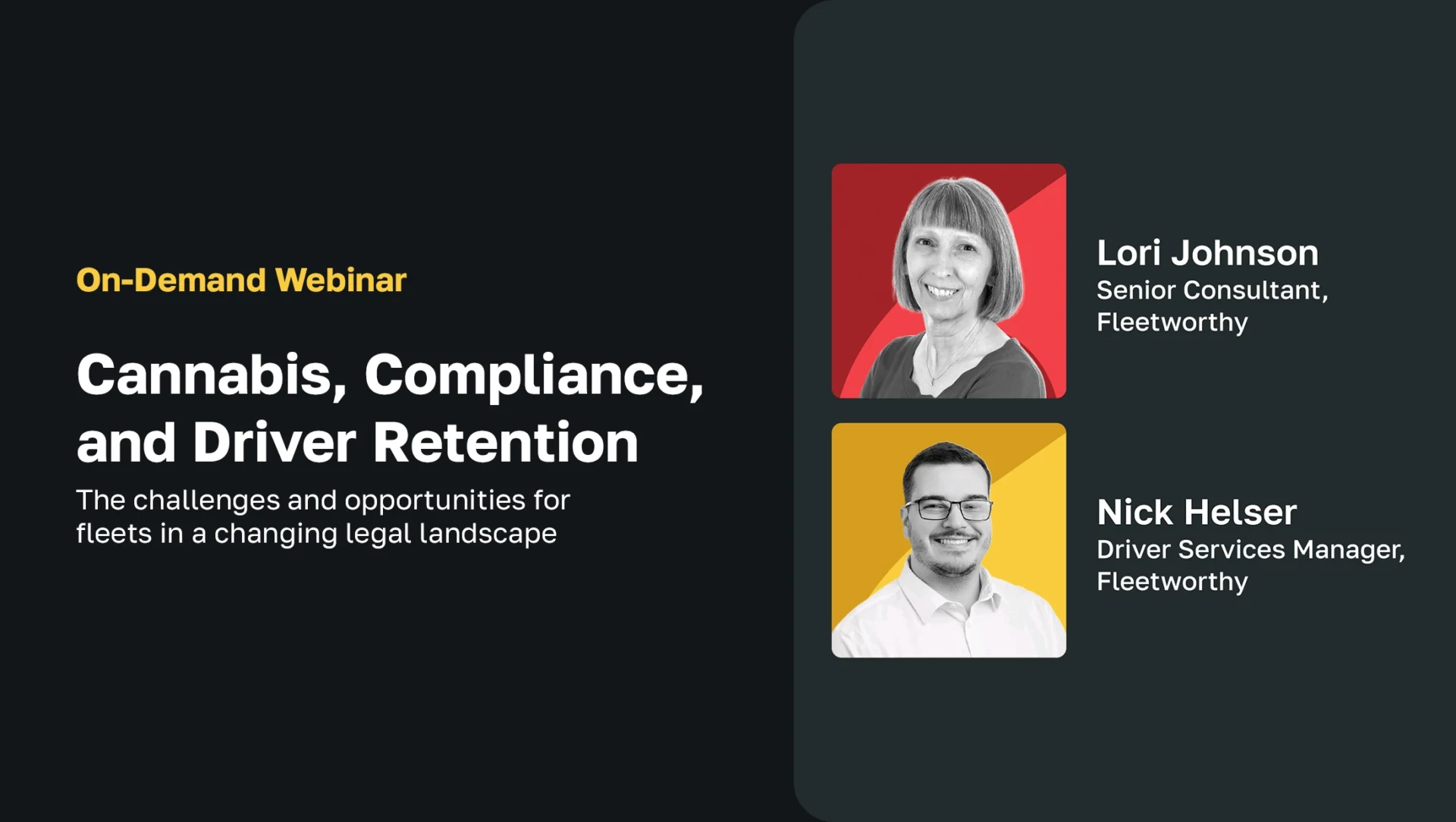
Lori Johnson and Nick Helter.
We’ll also have a live q
and a following the discussion,
so make sure you have your questions ready For our
presenters, before we get started, I’d like
to cover just a couple of housekeeping items.
First, if you have any issues during the webinar,
please feel free to access the help
section in your webinar console.
If you have questions that you would like to ask Nick
or Lori, please enter those, the q
and a box in your console,
and we will answer as many of those as possible
during the live audience q and a following the discussion.
We’ll also be sending a link to the recording
of this webinar tomorrow in case you’d like
to view it on demand or share it to colleagues.
And at this point, I will go ahead and hand over to Lori
and Nick to kick off today’s discussion.
Thanks Emily, and thanks everyone for joining us.
We appreciate you taking time outta your
busy day to join us.
Um, I’m Lori Johnson.
I’ve been with Fleet Worthy
for a little over three years now.
I do have 27 years in transportation industry,
mostly in food distribution and a few years in construction
before starting with Fleet Worthy.
All right, and hi everybody. My name is Nick Helser.
Thank you again for joining us today.
As Lori said, we’re really excited to be here
and represent not only some really good information
to take away, but also, um, just providing some context on
what can be a very multi-layered, uh, topic.
Um, at Fleet Worthy, I’ve been here a little bit less,
a little bit under three years.
I am the driver services manager, so I run several teams
and several processes that handle all of the services
that Fleet Worthy provides when it comes
to the driver portion of operations.
So that is anything to do with drug testing,
with pre-hire services, document flow, what have you.
So again, thank you for for being here.
So let’s start off here by talking about fleet worthy and,
and who we are and what we do.
So fleet worthy, if you are an industry aficionado
and have been paying attention in the news,
we have been quite busy over these last couple years in
terms of combining forces with some very strategic
and powerful companies to offer.
Ultimately, what is what we believe the ultimate suite
of products for compliance and, and ancillary services.
When it comes to operating a motor fleet,
we are the combination of a few different brands.
The first one would be legacy fleet worthy solutions, where,
where Lori and I are coming from the Bestpass company,
the Drivewise company,
and like I mentioned, a couple other, um,
specific services that, uh, that get along
with our full suite of service offerings.
So what does that exactly mean?
The first one is CP Suite
or Compliance Suite, which is our very unique
and proprietary compliance platform that fleets can use
to monitor their drivers, monitor their assets.
They can make sure that compliance
and safety is top priority with a very easy
to use and comprehensive, uh, suite of services,
even just within that one platform.
So a big part of that is compliance records, making sure
that your data is easily available and visible to you
or anybody within your organization that needs to see it.
On top of that, again, combining, uh, powers
with Bestpass Toll, really aiming
to simplify the toll management process
and also to make sure that your dollars are being used
as efficiently as possible in terms of
Form 2290s.
On the asset side, we do have Express Truck Tax
as another one of our sub-brands, which is expediting
and simplifying the process of filling out and submitting
and managing those particular forms.
And then of course, Drivewise,
which really focuses on way station bypass.
It reduces delays, it improves efficiency,
and it makes sure that everything that needs
to be communicated in terms of safety alerts
to keep driver’s, vehicles
and the rest of traffic we share the road
with in the best possible light
and the best possible, um, consistency when it comes to
actually maintaining those services.
As you can tell just by the brief description of each one,
when they are separate, they are great,
but when they are combined,
they really offer a comprehensive
and holistic way of managing fleet services.
What that means for our customers,
the biggest thing is reducing risk meeting regulations
and making sure that safety is top priority.
This happens with strong compliance solutions,
as we mentioned above, having a multifaceted way
of interacting with your fleet data
and making sure that nothing is missed when it comes
to making sure you are compliant with all of the regulations
and keeping your drivers and assets, um, up to date
and and compliant.
We also streamline everything we can.
So that is everything to do with fleet operations.
We improve efficiency in every aspect of what we touch,
and we also have a stellar group of subject matter experts
behind the scenes, always assisting our customers
and making sure that these processes are cohesive
with the operations of the carriers that we work with.
We optimize routes, we lower expenses,
we improve driver safety.
We have an optimal way of handling anything you can think
of when it comes to the fleet management side
of your company.
But what we are talking about today, the challenge
is conflicting rules.
And anyone who has interacted with
or managed fleet operations know
that there are several elements of doing so
that do sometimes conflict.
They sometimes have le potential legal ramifications.
They sometimes are just causing confusion when it comes to
how to actually manage your operation.
And one of the primary ones that we think was a very unique
and topical subject for today’s meeting
was the state laws versus the federal regulations when it
comes to specifically cannabis and cannabinoid products
and how that is such a great example of
how things can sometimes conflict and cause that confusion.
So what we’ll really be focusing on is the specific
regulations and opinions of that particular topic,
but also focusing on the macro problem
as you can see in front of you, which is how do we deal with
potentially conflicting laws
and ever changing regulations
that might not be completely in sync with each other
as time progresses?
To put that into a visual, right now, 23 states allow adults
to use marijuana re recreationally,
39 states permit medical marijuana with a prescription.
Now, not only does that separation
and that differential potentially cause some
of these complications in management,
but it also is pointing out
and reinforcing the facts that there are 50 states.
What that means is 50 different ways of notating
and potentially enforcing these laws.
Now, what we’re gonna get into
and what I think the central theme that Lori
and I will really be gravitating around is that federal
regulations always take precedent over state regulations
when it comes to fleet management and the F-M-C-S-A.
So we will get into a lot of those
specifics when it comes to state law,
but it is important to recognize
that the federal regulations are the ones that need
to be followed until there is a potential change
that more closely reflects those policies
with those in the states.
On that note, you will notice that some states
also have a much closely, a much more closely related policy
to the federal regulations,
where some states might be a mile
and a half away from actually having that cohesiveness.
All right, with that, we do have a poll question,
so please take a moment to answer when able.
Alright, so the question is, have you received a Department
of Transportation positive test
for marijuana in the past 12 months?
The options are obviously different channels
or types of tests that you put,
you could have received this positive result
for A would be pre-employment,
B would be a DOT recordable accident,
C is reasonable cause D is a return
to duty or follow up test.
And then E is simply, no,
you haven’t had this issue within the last year.
So please just take a couple moments to answer this
and we will be able to c how the trend relates
to our audience.
All right, so we have about half of the people
that have submitted a feedback here.
We’ll give it another 10 or so seconds.
All right, so moving forward here, we can see the results
with a overwhelming majority saying no,
which is overall, I think a good thing.
The obvious offender is pre-employment with a spattering
of DOT recordable, reasonable cause
and return to duty or follow up tests.
So we can obviously see that the trends
that we see at on the fleet where the operational level
does certainly follow the trend we are seeing here.
Pre-employment is by our records,
the greatest defender when it comes
to receiving positive tests for specifically marijuana.
I’m really excited that half the people haven’t
had any positives.
Yes, that is terrific,
and we can only hope that the, the,
the global trend remains, uh, consistent with that.
So thank you all for participating.
Um, I hope that helps shed a little bit light in terms of,
um, how we are seeing these results come back and,
and how we are able to get a feel for
where we’re going in the future.
So with that, um, I can go ahead
and pass it off to Lori for the next few slides here.
Yes, absolutely. And I’m, I’m jealous of all you people
that never had any positive DOT tests.
I mean, when I was A DER, I had many of them.
So, um, it’s kind of exciting that you’re not having to deal
with, um, some of these issues.
Um, at the end of the day today,
marijuana remains classified
as a schedule one substance under federal law.
I know there’s been a lot of discussion
and HHS, um, last administration made some recommendations
that it moved to a schedule three.
Um, it has not happened.
So what we need to keep in mind is
that marijuana still remains illegal on a federal level.
Um, it’s still in the DOT panel under part 40
where it lists the drugs that’s not changed.
So today, um, the drivers are all under the same rules
as they were, even if it’s, you know, it might be
the drivers in Colorado where I live,
and, you know, it’s definitely legal, um, state level,
but it is still a,
a schedule one substance under the regulations.
Um, even if it does get moved though, one thing
that people aren’t maybe aware
of is there has been discussion in the last administration.
They came out and said that even if it moves
to schedule three, they may choose to leave it in in the,
in the, uh, testing panel that DOT tests for.
Um, some of that reason is, you know,
you’re still in a safety sensitive position
and, you know, there could be issues with allowing drivers
to be on marijuana.
So that whole conversation, um, still has to be had
and a lot of things have to be worked out.
And one thing to remember is the regulations exist
to make sure that everyone is safe, right?
The whole goal of DOT is to make sure that all the drivers
and the motoring public,
that they return home safely at night,
that there aren’t any issues.
Um, so we have to have that balance discussion now that
marijuana is becoming more accepted nationwide, um, does
that make it okay
for someone in a safety sensitive position to partake?
Um, you know, there’s a lot of discussion on both sides.
I try to think of it as if I’m on the road
with a driver next to me, um, or on a plane
and the pilot’s taking me across the country, is
that something I want to be aware of?
Um, has this driver partaken of marijuana in a period
of time where they could either be impaired or intoxicated
and to add to the, you know, the disconnect
and to the conversation,
we don’t have something like we have for alcohol
to determine whether there is a, um,
an impairment level.
Um, a lot of people want to equate marijuana with alcohol,
can’t really do that
because alcohol typically, you know, depending on
how much someone’s had in their body type,
it’s typically out of their system within about eight hours.
Um, when marijuana, that might not be the case.
It could take three days or more, depending on use
and body type for them to lose the effects of
that, that drug.
Um, and we have that discussion
of impairment versus intoxication.
Um, studies have shown
that while a person might not feel intoxicated anymore,
they may still have some cognitive impairment
and maybe not making the best decisions in the heat
of the moment and going back to our driver on the road
or our pilot in the air, um, if they’re having
to make a quick decision
because something changed, um, we really want them
to have good cognitive abilities
and be able to make those decisions
in the heat of the moment.
So, you know, it’s, it’s a complicated discussion as, um,
you know, Nick alluded to at the beginning, there’s
so many facets of this
and we have to have a balanced discussion about
what really makes sense.
And as far as failed tests, you know, a lot
of you haven’t had any, which is great.
Um, when I was a DER
and right in motor carriers,
we definitely had our fair share.
And as marijuana use went up, we saw, you know, as the,
the laws changed and they changed rapidly, um, you know,
we saw more usage
and then we did have a few more positives
than we had in the past.
So it’s really important
that you make sure your drivers are aware
that DOT does have a zero tolerance policy right now,
and it is, you know, as we said, it’s a schedule one drug,
they can’t partake
and be in a commercial motor vehicle, so they need
to be aware of that, even if their state allows it.
Um, that doesn’t mean that they can partake.
And then also, we haven’t really talked about this yet,
but, um, CBD similar situation, right?
And that even adds to more confusion.
Um, I know some of the drivers where I had them call me
and say, well, I tested positive,
but I don’t know how I can, I only use CBD
for my aches and pains, right?
Well, the problem with that is
CBD is not a regulated industry.
So it could be
that there’s more in there than the label says.
If they’re long-term users, it can build up in their system.
Um, and now they’ve got a positive test, and guess what?
They have to go through the same process
that anybody else has to go through.
So it really makes for frustration
and some issues, you know, when you’re trying to explain
to your drivers, I’m sorry,
but you know, we have to take you out of the truck
and we have to go through this process.
So here’s our next poll question.
Um, have you experienced operational challenges
due to marijuana use?
So probably have
of our people haven’t since they haven’t had the positive
tests, but for those of you that have, um,
have you had to relieve a driver from a route
or have you had to adjust routes or terminate a driver?
Um, I know I personally have experienced all of these,
so curious to see what everybody else has experienced.
So it looks like we have a lot of no tolerance folks here.
Um, two thirds of you have terminated a driver due to, um,
a positive marijuana test.
So, um, you know, looking at some operational challenges,
I definitely had my fair share of these when I was in the,
in your seat.
Um, we’d get a call that a driver,
he took a random test two days ago
and now he’s got a positive test.
So now we have to scramble.
Um, you’re trying to get the green beans
and ketchup to the customer so that they have food
for dinner tonight, and now you’ve got deal
with what do I do?
Um, your driver, if he’s in town,
it might be a minor inconvenience if he’s hundreds
of miles away, it can be a real chore to try
to get another driver there to relieve them.
Um, let them take the route
and finish, get that other driver home, um,
creates lots of issues.
Um, we’ve also had to, um,
reroute maybe if you don’t have a driver that can take over
that route when it goes next, um, you might have to,
um, a lot of you are terminating,
so we’ll talk about no tolerance policies in a minute,
but, you know, this can really create havoc.
And now that you, you’ve got a late truck,
you get the pleasure of calling your customers
and saying, Hey, I’m sorry, I know the driver’s supposed
to be there in a half hour.
It’s probably gonna be later. We’re doing the best we can.
Um, just really creates a lot of issues
and a lot of process changes when you have something like
this And
your driver retention, you know, that’s part of the process,
um, personal experience.
Um, you have those positives
and you get those, um, issues that you have to deal with.
So, um, there’s some states you can’t
terminate on first defense.
So, um, you know, Minnesota’s one of ’em,
we had locations in Minnesota
and we had drivers that we were required
to put them through a program.
Um, there’s a handful of states that require that.
Um, other states, you know, they allow you to terminate,
but you have to decide from your company standpoint,
are you comfortable terminating that driver
and then going through the, the, you know,
the rehire process and trying to find another driver, um,
and taking the chance in six months you might have
that driver test positive
or do you wanna try to retain that driver, let them go
through the program and let them, um, you know,
stay on board and you’re,
you’re not retraining another driver in doing some of that.
But I know when we go through all these retention
and operational challenges,
that’s when Nick’s team gets involved, right, Nick?
So, you know, you can help ’em with all
of those testing criteria, right?
Absolutely. So we work very closely
with wonderful partners to make sure that not only are
the foundations of the drug
and alcohol services in place, but they are accurate
and they’re following the regulations as appropriate.
So that means setting up, uh, specific panels
for whatever job classification, uh,
requires those panels to be set up for.
It’s making sure that we work very closely
with the administrators
and managers directly from the motor carrier
to manage those drivers
and make sure that tests are scheduled on time,
that they are accurate, that we, um, provide the most
efficient and expedited results of those tests that we can.
And again, we have a, a wonderful support system of partners
that we work very closely with to ensure that we are
as timely and as, uh, serviceable to the needs
of the motor carrier as, as we possibly can be.
Absolutely. And you know, those return
to duty processes can be long and drawn out.
I mean, I know I’ve had everywhere from one year
to five years, and it’s a hassle to try
to keep track of all of that.
So I know I appreciated, you know, you guys being able
to do that schedule
and help keep track of all those follow up tests
’cause it is a chore to, to make sure they’re done on time.
Mm-hmm. So
where do motor carriers go from here?
Right? I mean, you’ve got a lot to think about.
You’ve got the conflicting regulations,
you’ve got the DOT versus the non DOT drivers, right?
Um, DOT is only for CDL drivers,
but do you wanna test your non CDL drivers?
Um, you can, but you know, you have
to check every state you’re in
and make sure that your policies are consistent.
Um, make sure that you have good robust policies
and that you follow them, right?
Um, it’s almost worse to have a policy
and not follow it than not have a policy
because in litigation that’ll really come back to you
and they’ll say, well, you have this policy,
why didn’t you follow it?
Um, making sure that your drivers,
as we said, they’re educated.
Um, I recommend that you walk the driver through the policy
in, in orientation.
Um, I don’t know any driver that wants to run home
and read an 18 page DOT policy.
Um, and unfortunately they end up being that long
to cover all the things that you have to cover.
So, um, make sure that they’re aware of it
and they can’t say they didn’t know that there’s a risk
of CVD that, you know, marijuana is illegal.
Um, and making sure that you’re, you’re doing that
and then exploring those testing methods.
Um, today the only option for DOT is urine.
Um, HHS hasn’t approved those two labs yet, so we can’t go
to oral fluid, which can create some,
some tension in states like California
where you can only test on the parent drug.
You can’t test on the metabolites,
but, um, hopefully soon they’ll get those labs approved
and then, you know, people can do what they need to do.
But there’s the push for hair testing in some industries.
Um, problem with that is you’re gonna see your positivity
rate go up even more
because it does stay in the hair longer.
And, um, you know, I understand why some industries want
to do that, but um,
it also can cause a little bit more issues in hiring.
And then in retention urine, that’s the middle
of the road, as we all know.
It’ll stay in that, that metabolite for, you know, anywhere
of two weeks or so, sometimes more depending on use.
Um, and it is the metabolite.
So you do have the issue in California, but
because DOT does overrule state right now,
they can test for urine.
Your only gray area is can I take personnel action or not?
And that’s when you need to get legal counsel involved on
that and determine your risk rewards on
what action you’re going to take.
And then oral fluid, um, that’s obviously an indicator
of more recent use.
It’s only testing the parent drug, so
that makes it a good choice.
Um, but I do know
that it can increase your positivity rate in the short term
because it’s a whole lot harder
to cheat on an oral fluid test than it is in a,
in a urine test.
Um, I know I’ve experienced situations where drivers tried
to cheat on a urine test
and thankfully most of them got caught.
Um, but with oral fluid it’s an observed test, so, you know,
there’s really no cheating on that one.
Um, so as you look at your policies
and once oral fluid becomes available, you may need
to update your policy, um,
and make sure that you are referencing the types of tests
or the situations you want, whether that’s urine
for pre-employment and oral fluid for post accident,
however you want to frame that program, make sure
that you do it in a way that um, it’s defensible
and you can consistently follow it.
And then, um, last
and definitely not least, make sure
that you have good safety
and compliance systems and partners.
And Nick, I’ll let you talk to that.
Um, you’re, you’re involved in this
all the time with clients.
Yeah, absolutely. And I can really speak to the efficiency
and, and, uh, comprehensiveness
that our CP suite system has to offer.
It has customizable data tiles, it has that,
that our exportable, uh, where all of the data
that you want is at your fingertips
and completely able to manipulate for your own numbers,
but it also keeps a reliable data track for drivers in terms
of documents, um, where we can customize expiration dates.
Uh, so we always stay on top of ordering, you know,
documents in a timely way.
So you’re within regulation specifically
to the drug testing component.
Uh, we, you know, every result is posted
directly into the driver profile,
which gives you next level visibility into
not only the timeliness
of seeing when the result is available,
but also just being able to actually, um, observe
and take notes in a, in a greater sense
of operation when it comes to
what those documents actually result in.
And then in turn for the motor carrier,
the real benefit is you can make more confident decisions
and you can make more confident policies that reflect
not only the trend of where your drivers are,
but the regulations that we adhere to.
Exactly. Alright,
and so our next poll question is,
would you like our sales team to reach out
and provide more information on any of our services?
So we have the safety
and compliance, the toll the way station.
Um, if you wanna, um, explore more than one
of these options, just click on one of them
and the person that reaches out to you,
we’ll help you navigate that
and determine where it makes sense to start best
with what your needs are.
And then if you want the white paper,
I know Emily said it would be available for download,
and then also we have the QR code here if you want
to scan and get it that way.
And Emily, I think we’re ready to see what kind
of fun questions that the audience has for us.
Yes, absolutely.
Uh, thank you again to Lori
and Nick for your insight on this discussion.
I know it’s very helpful for our audience
and yes, I’m not surprised,
but we’ve got these questions coming in, so get ready.
Um, I’ll try to kind of go in order,
but I I might skip around a little bit.
Uh, we’ll, we’ll just see.
We’ve, we’ve got some interesting ones.
Um, I’ll start off with this one is testing only
for CDL drivers or can I test my non CDL drivers as well?
Um, DOT testing is only for your CDL drivers
when they’re operating a CDL vehicle.
So if you’re gonna hire a CDL driver, you need
to do pre-employment DOT testing if you choose to do testing
for a non DOT driver.
So a non CDL driver, I mean, um, you can do
that if you have a non DOT policy
and you know that what your state allows you to do.
So some states limit what you can
and can’t do in a non DOT situation.
So it’s definitely something that you want
to seek out legal counsel
and make sure that all your regulations,
you are not going against anything the state allows
or disallows.
Excellent. Thank you Laurie. Um,
I’ll move on to the next one.
Does DOT always overrule state laws
As far as testing?
Yes. Now, as I alluded to in California,
there’s some gray areas with what you know,
because you’re testing urine, um, you may
or may not be able to take action,
but if it’s a DOT regulated DRI CDL driver, then yes,
the DOT testing would take precedent over the state.
Excellent. Um, I’ll hop on to this question.
Does CBD carry the same penalty as THC?
Unfortunately, yes.
So there is no valid medical reason to have
that in your system,
and since it’s not regulated, um,
it can build up in your system.
And as we said, that label may not be reality.
If it says 0.0%, it could be more.
And if it builds up in your system
and you get that positive, you have to go this
through the same return to duty process as any other drug.
Yikes. Well that’s good to know. Yeah.
All right, let’s move on to the next question.
How do hair, urine,
and oral fluid test differ on results for THC use?
And we alluded to that a little bit earlier,
but just to, to re remind everybody, um,
the hair keeps it the longest.
So, you know, there are some industries
that wanna do hair testing
and they’re pushing to make that accepted by DOT,
which it is not currently.
Um, there’s been some action to let,
let it be allowed in DOT, but right now it’s not.
Um, urine typically a couple weeks it’ll stay in there
and then oral fluid is the least, it’s the best indicator
of recent usage.
So it’s typically one to three days depending on the person.
Got it. Um,
and then speaking of testing, let’s kind
of follow up with this question.
What is the California metabolite
issue you were referencing?
Okay, so California, about a year ago,
and I can’t remember the number,
it’s like AB 2155 or something.
It’s a new law that they enacted saying
that you could not take personnel action on a drug
that tests for the metabolites of the drug, which is
what urine testing does.
And in the regulations it says it’s testing
for the metabolites.
And I don’t know all the science lingo and all of that.
I just know that, um, urine test does the metabolites
where oral fluid only tests
for the parent delta nine parent drug.
And so, um,
you can take personnel action if you’re only doing
a test on the parent drug,
but unfortunately urine test metabolites.
And so that makes it, that gray area I talked about
with DOT testing.
Um, you’re getting a positive result on metabolite,
but the loss, you can’t take personnel actions.
So that’s that gray area of de of federal conflicting
with state and how do you resolve that, so,
Got it.
All right, let’s move on to the next question.
I think this is a good one too. If your company policy
for CDL drivers explicitly states
that you have a zero tolerance policy
for positive marijuana tests,
can you still terminate in the states
where it is still legal?
Yes. If that’s what your policy is
and that’s what you do, then you can do that.
You just to make sure that you always do it
and you don’t play favorites.
Now again, as they said, subject to the state law,
’cause there are at least a couple states
that say you cannot turn on first offense,
Minnesota being one of them.
Excellent. All right. Lots of, uh,
questions coming in about drug testing, Lori.
So I guess some of these, most
of these are probably gonna be geared towards you.
Um, but let’s move on to this question.
What happens when the driver is the victim
of a laboratory error
and is marked with a violation, same day,
negative DOT drug test three test hair negative
by a police forensic specialist
and the F-M-C-S-A doesn’t remove the violation?
Um, first of all, hair testing’s not allowed by DOT, so
that test wouldn’t be a valid DOT test.
You would go with the urine test.
So I’m not sure totally what
that one’s leading to.
Well, I think too, like
what happens if somebody’s a victim
of a laboratory err in general,
like is there something else you can speak to that
Yeah, there’s an appeal process.
I don’t have every step memorized, haven’t done it
for a while, but there definitely is an appeal
process they could go through.
Got it. All right, let’s move on
to the next question.
Any tips on finding SAP people to send drivers to?
Yes. Um, we, we refer them to our EAP program
and they help them find a counselor.
There’s also just SAP list.com you can go
to find someone in your area,
but usually we refer ’em to our EAP program
and then they would help them.
Yep. And, and if I could just add a little bit to that,
um, the, the fleet worthy, uh,
services process is Lori mentioned, the SAP list, uh,
website, that is traditionally what we offer.
And then we have also recommendations from that list, uh,
depending on region
or depending on preference of the clinic.
Um, you know, we can, that that’s part of this, um,
the walkthrough service that we provide when a positive test
is recorded and when a driver does have to select a program,
um, we really try to help the motor carrier
streamline that as much as possible.
Mm-hmm.
Got it. Very helpful. Thank you, Nick.
All right, let’s move on to the next question.
What about DOT 3 82 0.119?
The stand down rule?
What steps do I take in post accident testing
to ensure my driver is not continuing
to drive while awaiting test results?
Well, I don’t know that r off the top of my head.
Um, I would tell you there is not a requirement that you
keep your driver out
of the truck while you’re awaiting the post-accident tests.
Now some people choose to do that,
but um, I know in the companies I was, were was in,
they were large companies
and we couldn’t have everybody waiting
for a post-accident test be out of a truck
or even in the warehouse, right?
The non DOT tests, we didn’t keep them off the floor
until that test came back.
Unless you have that reasonable cause thought
that there was impairment was a factor in the accident,
then we would keep them out of the truck.
But mm-hmm there’s not a requirement to keep them out
of the truck waiting test results.
Interesting. Good to know.
Alright, we’ve got another question, Lori.
Um, seems our audience has a lot of questions
with the testing in California, so I know you kind
of touched on that, um, with the previous audience question,
but I’m gonna ask this one
and maybe you can kind of of help like reiterate.
Um, but this question is, with that issue
with testing in California, does that only apply
to companies and drivers who live in California
or does it apply to anyone tested in California?
I’m not 100% sure on the California law,
but typically testing is based on the state of residence.
So I would say probably California residents,
but again, I don’t know every single little piece of
that law to know if it’s somebody passing through,
my guess is it’s residence.
Got it. Yep. Yeah, me
and Laura, we talked about this earlier.
Um, maybe that might be like a seek legal
counsel Yeah, exactly.
Type of situation.
Definitely. Yeah, Lori’s here to advise as much
as she can, but there are some things where, you know,
Legal, I cannot provide legal advice.
Yeah. All right, let’s move on
to the next question.
Uh, this is okay, this is a good one.
Um, seems much
of the younger CBL driver generation is deciding
to abstain from alcohol as they tend to prefer cannabis
among other alternatives to booze, alcohol, et cetera.
Curious how the DOT
and other regulators are addressing this aspect?
Well, currently marijuana is still illegal,
so they’re not changing their minds on that in large
because of the safety sensitive nature of driving.
So, um,
time will tell if a new administration has a different
philosophy, but right now it’s not been downgraded
and it remains illegal, so
Mm-hmm.
I, I think it it is related to, uh, kind of catchall to
where if a substance alters the ability
to potentially operate machinery of that magnitude, um,
you know, it, it’s better safe than sorry.
At least that’s kind of the, um, the, the feeling
of the current regulations on a, on a federal level.
Yeah, you’ve got that safety sensitive thing to deal
with, so, mm-hmm.
Absolutely. All right, let’s move on
to the next question.
Are CDL drivers with a valid medical
marijuana card still subject to these regulatory guidelines?
Absolutely. Medical card is not a prescription, it is not
in the current world with the current regulations.
There’s no valid reason to have me marijuana in your system.
So medical card doesn’t matter for a DOT test. Mm-hmm.
That’s good to know. I think we’ve
pretty much covered all
of these questions that come through.
I do have a couple more minutes guys,
if y’all have some more questions that you wanna submit,
but if no other questions come through, Nick, Laurie,
do y’all have any other comments that you, um, wanna say
or Nick, I know we didn’t really get to get too many
questions for you, but, um,
anything you wanna comment while we’re waiting on maybe a
few more questions to come through?
Sure, yeah, I just wanna reinforce, uh, you know, what
the fleet worthy suite of services can provide.
But also I also, you know, just to, to echo
what Lori has been saying
and what we’ve been kind of tangibly approaching here is
that it is critically important that whatever you
as the motor carrier have as your internal policies,
as the way of operating
and managing your fleets that kind of like the one
of the last slides mentioned, you really need to make sure
that you are aware
and that your drivers are being properly trained to be aware
of these differences of what the impact of some
of these gray areas between state
and federal regulations can mean
because it is just, especially for larger fleets,
it is one misstep
and that can have cascading effects depending on, you know,
the severity or the consequences of, of the occurrence.
So just make sure, uh, everybody out there,
make sure your policies are up to date.
Make sure you, you are very aware of regulations
where your drivers are domiciled or residents
and with how that corresponds to the federal regulation, um,
I would very much advise that you stay up to date
with any F-M-C-S-A updates
because no pun intended, this is kind of a fluid,
uh, situation.
Um, you know, we all know how quickly
and how drastically regulations can change sometimes
and it’s very important to be on top of that
and of course to match make with a, uh,
proper compliance platform
and manage services to further ensure
that you are indeed going beyond compliant.
So, mm-hmm. That would be my,
my closing comments if you will.
Yeah, absolutely. Thank you Nick.
We do have a couple more questions that are coming through.
I think we’ve got time to answer these.
Um, so I’m gonna start with this one again, it’s kind
of touching around the testing questions
and like more so like y’all’s opinions on
what we think the future will look like.
Um, but this question is, have any of you heard
of any movement behind the scenes about changing laws
to allow THC use by CBO drivers when not driving?
Well I think that touches on the intoxication versus
impairment situation.
I mean, if they’re using on the weekend
and then come to work on Monday,
are they still impaired or not?
So currently the system says if you have enough in
your system to pop positive on a test,
it doesn’t matter when you, when you partook, if you’re
meeting that minimum level to have a positive test,
then you’re gonna have to go through those hoops
to get back in your truck.
Mm-hmm. Yeah.
Alright, let’s follow up again with another, uh, question
with the medical marijuana card.
Mm-hmm. So does that mean that a driver
with a medical marijuana card, like for cancer,
cannot drive a truck since they would test positive?
My opinion, it would be questionable.
Um, definitely when they get their um,
medical card from a DOT doctor, they need to mention that
’cause it could disqualify them.
Um, and they also need to be aware that if they’re,
depending on how much they’re taking
and when they’re taking it,
if they have enough in their system
that a test would pop positive,
then yeah it would disqualify them.
So I think it’s something they need to discuss
with their medical doctor, their DOT doctor
and get everyone on the same page
because again, you’ve still got that, um,
intoxication impairment situation if they’re habitual users
of it and I understand the medical part of it,
but it could be disqualifying.
Yeah, good to know.
All right, um, I think we’ve got our last question
and this is kind of like a two part, um,
so it’s a little bit long, so bear with me
and if I need to repeat anything, you’ll just let me know.
If my crew drive a CMV up
to 26 KGVW non
CDL one,
the F-M-C-S-A is into effect even though it is legal
up to five nanograms in Washington state.
And then part two of that,
however, with the U-S-A-D-O-T number on the truck,
we must follow F-M-C-S-A at zero
compliance regardless.
So the DOT regulations are only
for trucks over 26,000 pounds
and a CDL driver.
So you’re not going to be subject to the DOT drug
and alcohol testing at those situations.
You would be subject to your company policy
and your state laws
and I don’t know every state law, so, um,
sounds like they’re in Washington
and I know they’re like California.
They have some one-off rules that I’m not necessarily aware
with, but the main thing is you’re under 26,000 pounds,
you’re not a CDL driver, you’re not a CDL vehicle.
So it’s not, um, gonna apply.
Excellent. Yep. And, and Lori,
that’s actually a great point
and I was, I just thought of that
as potentially another thing to close out here.
Um, we would be remiss to say that, you know, the state,
some of this in context might sound like the state
regulations are just worthless.
Don’t worry about it. But that is not the case
if they are a non CDL
and not applicable to the DOT regulations.
That is something to where Lori just mentioned.
It is about company policy
and it’s about the state regulations.
We alluded to earlier in the slideshow
that 50 states means 50 different ways
of notating or interpreting these different laws.
And it’s very important
that everybody stay brushed up on the states
that are relevant to your operation, especially for drivers
that might just drive a pickup
or might just drive a company car
or anything below that 26,000 pounds.
So something very important to keep in mind.
Yeah, that’s a great point Nick.
And I know I live in Colorado,
they define a commercial motor vehicle at 16,000 pounds.
Now you don’t need a CDL to 26,
but even California 10,000 some regulations kick in.
So it’s really important to understand your states
and some of them have their own drug
and alcohol regulations, so you really have
to know those state laws.
So thank you for bringing that up.
No, thank you. Yeah, absolutely.
A lot to navigate and I wish we had more time,
but unfortunately we are running out of time.
Maybe we should do like a part two it seems like
because, um, again, it’s, it can be challenging a lot
of gray area, not so black and white.
So, um, again, we really appreciate, um, Nick
and LaRay, y’all coming on here and giving your expertise.
As we mentioned, um,
we do have the white paper available via that QR code.
Um, and then it’s also on your webinar con console if y’all
want to download that and just kind
of get a little bit more information on the findings, um,
regarding this topic.
And then there’s also a few other resources
that we included in the webinar console
that are just different, um, white papers
that you can access, um, that might be helpful for you.
So with that, I’m gonna go ahead
and wrap things up here.
So again, just a big thank you, um, to Nick
and Lori for sharing your insights with us today.
I know this was a very, very helpful session, um,
for our audience members in navigating
this tricky landscape.
So thank you again, um, for your insights.
And as a reminder, the recording of this webinar
will be sent to, um,
our viewers here via the email used to register with.
So if you need a copy, that’s where you can find it
and we hope you will join us again
for our next freights webinar.
And with that we’ll go ahead and conclude
and thank you everyone for your time.
Thank you.
Read Transcript
Cannabis, Compliance, and Driver Retention
The legalization of cannabis is reshaping workforce challenges for fleet managers, creating a complex compliance landscape that directly impacts driver retention. With an industry already facing an 80,000-driver shortage, understanding the risks, regulatory pitfalls and creating clear policies is more important than ever.
Watch as Fleetworthy compliance experts Lori Johnson and Nick Helser for expert insights and actionable strategies to navigate these evolving challenges.
With driver shortages projected to grow and compliance regulations evolving, you can’t afford to be unprepared. Watch today and ensure your fleet remains safe, compliant, and efficient.