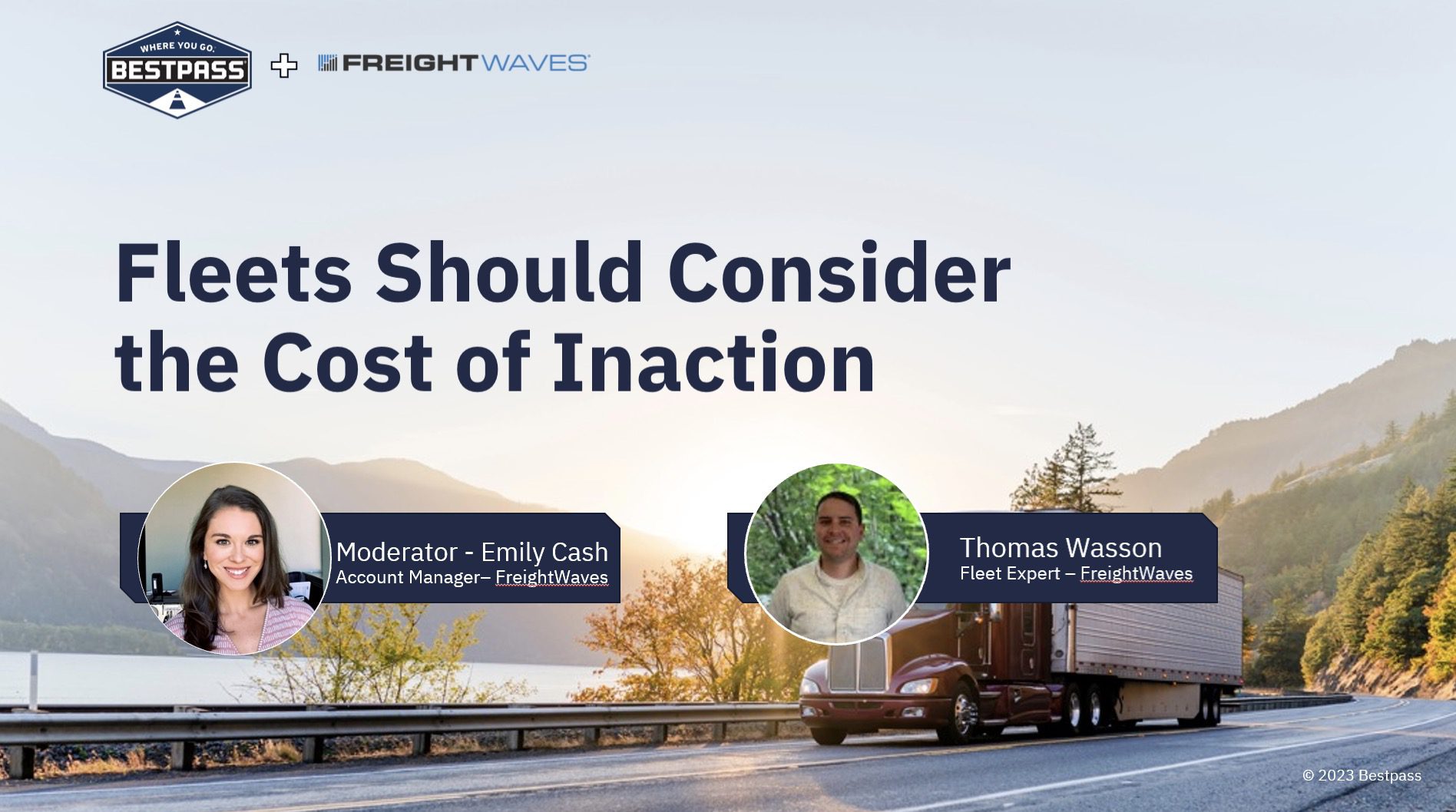
Welcome everyone. Thank you for joining us for today’s webinar.
My name is Emily Cash Freight Waves account manager,
and I’m happy to present this webinar in partnership with Bestpass. Today,
we will explore freight waves and Bestpass partnering on a recent white paper
survey that explores fleets of all sizes across the United States to
share specific information regarding their company’s expense reports,
projections from 2022,
and their overall satisfaction with 2022 and confidence in the 2023.
I’m happy to be joined by Thomas Watson,
enterprise Trucking carrier expert at Freight waves. Before we get started,
I’d like to cover just a couple of housekeeping items. First,
if you have any issues during the webinar,
please feel free to reach out to our team via the help section or the audience
chat function and your webinar console.
If you have questions that you would like to ask Thomas,
please enter those through the q and a box in your console,
and we’ll answer as many of those as possible during the live audience q and a
following the discussion.
We’ll also be sending a link to the recording of this webinar tomorrow in case
you’d like to view it on demand or share it with your colleagues.
And finally,
you can download the white paper that we’ll be discussing today with the
complete findings via your webinar console. So at this point,
I’ll go ahead and turn it over to Thomas to kick off today’s discussion.
Thank you, Emily. Super excited.
Gonna kick it over here to what we’re gonna be focusing on today. Uh,
we got a great, great piece of, uh,
white paper here that we’re gonna be going through. Uh, not only, uh,
fleets and budgetry concerns, but expectations moving into the year.
A little bit of background for myself.
Five years at US Express Fleet management, dispatching freight analyst,
and I finished as in charge of their truckload network design for their O T R
network. Uh, did a standard arrive logistics account manager and carrier rep,
and just recently came from trucking tech startup AI fleet OUTTA Austin, uh,
senior operations manager there. So, uh, I’ve been a,
been a little bit around the,
the thing here at a 2,500 truck business unit and then, uh, AI fleet.
There are a little over a hundred trucks now. I remember we started about five.
So, uh, these are some good topics. Uh, normally I, I work in the media game,
but I did come from truckload operations.
So these are areas near and dear to my heart.
Make sure if you have any questions, of course,
put ’em in that chat box midway through the presentation,
we will have a poll, so if you wanna fill that out as well,
should be pretty good. So let’s begin. Uh, going through these si uh,
slides here. I’m gonna be talking about not only what the data is,
but adding a little bit of commentary based on experience. Um, you know,
figuring out right now, the biggest thing is majority,
at least 64% talking about being over budget. And I mean,
when we look at being over budget,
it becomes abundantly clear just because costs across the board for fleets went
up higher driver wages, higher fuel prices, higher equipment prices.
If you look at the cost of new and used class eight tractors, you know,
during that 2022 time, it was just much more expensive in spite of, uh,
you know, the interest rate environment that was, uh, slowly ramping up.
You were generally paying for more things. So, you know,
this didn’t really come by, uh, too much of a, a shock, but, uh,
at least having half of respondents being over budget.
This thing happens when you look at managing your costs.
If you’re a smaller fleet,
a lot of times you’re too busy booking your trucks out for the day,
you’re dealing with putting out fires.
It’s really difficult unless you have the time,
which frequently you don’t to look back and check. So,
really good data here. Um,
I’m gonna go through this next one here because inflation did have, uh,
an impact, but 12% of fleets being lower than the target.
Shout out to those folks need to see what they’re doing.
We’ll have to interview them, uh, by category.
This is something that’s important here. Uh, fuel continue to rise,
and if the fuel costs, uh, if you look at some of our data, you know,
we’re up $4 plus per gallon, uh,
and we’re currently down to around d o e around the three 80 ish range. Uh,
so we, you know, we are seeing in least in this current phase,
but looking at 2022, that was one of the big narratives. Uh, the first quarter,
by the end of q1 February, we had the war in Ukraine causing a spike. Uh,
those of you don’t know that Russia is a large producer of diesel.
And so having the, uh, corresponding sanctions and, uh,
the volatility didn’t help, but, you know,
why was fuel so much more expensive compared to maintenance and equipment.
Another fascinating thing, talked with, uh, freight webs,
old expert John Kingston, back on Xam. And, uh,
one of the big topics was i o 2020, which is a, uh,
lower sulfur distillate type of fuel being used for maritime.
So all you need to know is one of the reasons fuel jumped up as well is also
it’s competing for space. If, if you’re filling up your tank, you’re using all,
uh, ultra low sulfur diesel, U S L D. And the stuff that, uh,
used to be in shifts was a different type of really crappy, uh, distillate.
And so now with the requirements, it’s not quite as good as ultra low,
low sulfur diesel, but it’s competing for refinement space.
Imagine you’re fighting over a barrel of crude oil and diesel used to have its
own territory, now it’s being encroached.
So when we’re talking about fuel pricing,
part of the reason that it was so high,
and part of the reason it still is high now,
was because maritime as well as demand, uh,
played a huge factor. So, uh, second one, looking at maintenance. Uh,
these things looks like were rated out of five.
On a scale of one to five maintenance, cost went up, technician shortages,
lingering parts, uh, you know, we talked about it for two years. Uh,
one of the biggest things is that it was hard to get repair parts. I had, uh,
I talked to back in, uh, 2021,
best conversation was I was at a Volvo dealership trying to get one of my trucks
repaired, and they said, well, we have 22 trucks brand new on the lot.
They’ve been here for six months,
and they don’t have actuators for their mirrors. And so, you know,
little things like that. Uh, when you’re outside of, uh, truckload operations,
it’s causing problems.
You’re also paying higher maintenance costs because of the lack of parts. Uh,
the higher wages,
the technician shortages that we’re still dealing with ongoing, uh, loves TAs,
Petros, all the travel stops were operating at lower, uh, you know,
capacity in terms of, uh, employees. So their labor was messed up. And I mean,
that trickles down. Uh, if you only have one loves, uh,
unit that can go out for roadside, and you’re used to using five, you know,
time is money,
maintenance costs are going up and they’re naturally gonna charge more. Uh,
finally, equipment and driver pay. This stuff’s self-explanatory.
We were very much in a situation where the cost of, uh, newer equipment,
the cost of used equipment had been high. It’s demand driven.
Everyone’s entering the market, driving up prices, and, you know,
OEMs were not able to build due to shortages as much as they wanted to.
And, and they also took kind of a more conservative approach. Uh,
build slots and stuff were not really expanded as much until, uh, recently,
and so we’re still seeing that lingering impact.
So 2022 data right now doesn’t surprise me too much. Uh,
driver pay is the most fascinating one as well, just because, uh,
drivers were in such high demand. Uh,
we remember all the way up through the first half of 2022,
we still had a pretty, pretty strong environment. Uh, by March,
it was really good freight Waves day had picked it up in April,
it started tanking. So, uh,
it took a little bit of time before everyone realized, uh,
like a game of musical chairs that the music stopped. So by June, uh,
other outlets, uh, became abundantly clear that we’re in this, uh,
deflationary and freight recessionary environment. So, uh, driver pay went up.
Uh, my personal opinion is it’s probably gonna stay stable. Drivers.
We talk about a thing like a driver shortage.
Just remember that this is a very large statistical number.
It’s saying that we potentially need this many drivers to fill it,
but it’s very elastic right now with a, with a soft freight market.
Drivers are not gonna get the same kind of wage increases, uh,
that they did in years prior. So I, you know, I fully expect if we ask in 2023,
we’ll probably see that driver pay, uh, you know,
I’d say right near the middle of the pack. But, uh,
I don’t think insurance and total expenses are gonna be putting up that much of
a fight. So let’s kick it over the next slide real quick. Uh,
performance and satisfaction. So, uh,
how satisfied you’re by your fleet’s performance. Uh, you know,
interesting things, uh,
coming out of five indicates you’re very satisfied and a one means that you
are not very satisfied. So, uh, looking at size, I think is,
uh, is pretty good. You know, the, the coolest thing I take away is one to five.
You’re very, very happy with your reliability.
And then 501 plus you’re doing pretty well. But I,
I think the six to 100 and the 1 0 1 to two 50 range is really interesting
because you’re in the growing pains, uh, uh, stage. You know,
you need more assets, you’re trying to get funding, uh, you know,
you’re scaling up your operations department and you’re feeling that, uh,
you know, if you have 250 plus tractors, you’re,
you’ve either been around for a minute or you have a strong operational, uh,
background. Uh,
back when I rolled into a team business unit at US Express was around 500
trucks. We had a team of approximately like 12 ish dispatchers,
55 trucks. You got an idea of what you’re gonna do. Uh, but when you’re growing,
you can really tell, because it’s hard to just find the labor, uh,
driver behavior is, is interesting. And that really, uh,
speaks to an interesting factor where one to five,
you can get good drivers, uh, because you can, you’re choosy.
You have five trucks topped. You don’t wanna mess it up. You need safe drivers.
It makes sense. You, you get your pick of the litter, so to speak. Uh, 500 plus,
you know, you’re typically pulling out from CDL schools.
Average drivers been around less than six months. I know that, uh,
50% of all drivers outta CDL school at a large enterprise carrier only made it
past six months. But when we did the studies,
the ones that le that stuck around by the end of the year were actually
more likely to stick around long term.
So it is really interesting because you see this matriculation to where they’ll
leave large fleets and go to the smaller ones. So, you know,
when you’re looking at the ones that jump ship six to 101 to one to two 50,
still in the growing pains, I’ve seen it before. I saw it on my last startup,
you’re scaling. You can’t be as choosy. Uh,
you don’t have the recruiting team. A hu you know, uh, a large carrier,
like a hunt, a Schneider, US Express and whatnot,
has an entire department that is, uh,
nearly as large as operations to vet. Uh,
I remember talking to a driver recruiter, and out of a hundred,
you’d maybe get five or six, uh, because you’re looking at,
was your DAC report bad? Did you have drug and alcohol? Do you have accidents?
Uh, you know, were, we’re looking for ways to say no.
I know that a lot of times on social media drivers talk about how anyone could
get in, but at the same time, you know, you’re gonna,
you’re gonna have to be a lot. Choose.
So this doesn’t surprise me a lot because you don’t have the
staff until you get past like 250 trucks to vet.
So you either have enough bandwidth to deal with five or when you start growing,
growing pains. The final ones that I think as we’re digging through this, uh,
route optimization and efficiency,
it really makes sense that 500 plus truck carriers struggle
with this or are not as satisfied. Uh,
just because when I did truckload network design, we worked with about,
uh, let’s see how many loads per week, 7,000 loads per week.
We had to fill a bucket of about 7,000 loads per week.
And so it’s literally like a scatter shot. Uh, it’s such a, uh,
diverse dispersed thing that I had a pricing team. I had pricing analyst,
I had a customer, uh, customer success managers. I had load planning operations,
I had fleet operations. Everybody wanted to talk about something.
When you have like one to five trucks, you’re all of that, that’s, that’s you.
So, uh, it makes sense why, you know, we’re gonna see degradation. Uh,
the biggest one was two 50 to 500.
You can still manage that with about a team of like five. So you can,
you can figure that part out.
But once you get past that infinitesimally complex, finally,
maintenance efficiency, I think this number is indicative.
No one can really win. Uh, you know,
whether you’re using a small fleet or a large fleet, uh,
large fleets have terminals, but they’re still running into parts shortages. Uh,
they’re still running into issues where there’s an entire team.
You’ll see ’em on LinkedIn and stuff for large fleets that they’re recruiting
for it. Uh, you know, it, it’s,
it’s the same status where if you have a roadside event,
you’re going through a third party vendor instead of a Penske or somebody
calling for one to five.
It’s the truckload carriers internal maintenance network where you have trucks,
trailers breakdown, triage. So I think this is a great one just to show that,
yeah, it, it’s almost like, well, it’s good enough. And,
and I don’t think it could have been better just because you,
no matter where you were,
it’s not like you could win over somebody else when you’re dealing with roadside
events. Cuz when you’re down in like Butte, Montana,
it doesn’t matter if it’s one truck or 5,000, you’re just stuck.
So kick it over. Fleet performance, um, this is a fun one. Uh,
fuel efficiency is always the most commonly tracked metric. Uh,
when I was at a large carrier, it was a fuel department that dealt with that,
or it was, um, I mean, we, we purchasing,
like I I managed fleet ops. When I did truckload network design,
we cared about AB points. Uh, how far were your nodes?
What’s your deadhead or empty mile percentage? How wasteful are you?
So if I’m in Columbus, Ohio,
and I have 150 mile radius between my two furthest shippers,
I’m gonna bring that down to like 75 miles.
Those are kind of ideas that we’re looking at. But on the back end of the org,
you’re gonna have an entire group that’s saying, okay, well,
I’m ordering a combination of Cascadias.
I’m ordering a combination of peterbilts. I’ve got some Volvo Thoses in the mix.
How much am I paying? How efficient? Do these work really well? Are they,
are they working into my existing fuel routing, uh, guide? Uh,
we have developers that did the fuel routers, driver tech units, uh, samsara,
Omnitracks, they all send this stuff down. So I mean, it’s a big deal,
but a lot of times in a large fleet, it’s back office grumblings.
We’re at a small fleet. It mattered a lot because it was like, crap,
the end of the week. I, I spend a lot of money on this. So 79.6, to me,
that’s anything above 75% screams to me that everybody’s paying attention.
Uh,
my favorite one is the 25% rule and statistics where 25% of people will just say
anything. And so luckily looking at this, we don’t have any of that.
So we do have, at least on our survey sample,
we have a very good amount of people that we’re, uh, putting in, you know,
as about honest answers as you can get, uh, utilization’s,
big driver behavior’s, big scheduling, maintenance scheduling,
like notice route efficiency at the bottom.
Because when you’re in an environment that goes from you being in control and
charging a high rate to you not being in control of pricing,
you don’t have the luxury of picking. And what do I mean that, well,
if you’re making four bucks a mile, I don’t care about the empty miles,
like five bucks a mile, I’ll, I’ll charge you for it.
But if I add an extra 50 miles to that load and I pick up that empty mile
percentage, I’m making so much more over my cost that I’m,
I can get away with being sloppy. Uh, and we saw that behavior in two years,
sloppy, sloppy behavior, but the money’s there and I could throw it on a wall,
uh, in a tight market, the, the in the inverse happens.
And so I’m booking when I have 7,000 loads,
or I have booked five loads for my trucks today, I’m stressed, I am concerned.
And, you know, if I didn’t do my job right, which means booking in advance,
hopefully, uh, I’m gonna have to take it my route efficiency will suffer.
My empty miles will go up. You know, uh, it,
it’s hard to keep track of regularly because you’re just so concerned at the end
of the day, regardless of the size you’re booking it. So, I mean,
from my personal experience, this stuff makes a lot of sense.
Driver behavior is normally top of mind. Uh, did you have a speeding event?
Did you have an unsafe driving event? Do I have to coach you for something?
Did you mess up your logs? Happens a lot.
Did you improperly use personal conveyance for six hours?
And I have to terminate you. I mean, these things are, uh, a lot from,
from my personal opinion, fleet performance, you know,
revenue per truck per week, revenue miles per truck per week.
And then net rev if you can. Uh, smaller fleets,
you can’t really always do net rev, a small fleet likes rate per mile because,
uh, you want to think off the top of your head, okay, about a buck 80,
I’m better than a buck 80. I know I’m getting yelled at. Uh, but you know,
when I came from my startup, we were thinking like,
I want 4,500 per truck per week, uh, in a down market environment. Now, uh,
when it was stupid hot back in 21, uh, we got lucky,
we had like eight to 10,000 per week. Like it was pretty good a US Express and,
uh, Schneider and a Hunt and Werner and all the others,
you’re looking between like 35, 45. I mean,
they were scraping over 5,000 per week. But it’s, it’s usually like, uh,
with that many assets on the road, you’ll see small changes.
But with one to five, like huge fuel efficiency though still feels big because,
you know, a lot of our samples, uh,
and I think this was between a hundred ish trucks,
we were in that goldilock zone. So for fuel efficiency,
this makes more sense why this would be more skewed because a lot of our
respondents were medium-sized fleets where, uh,
I’m finally large enough that I’m pinching my pennies. I’m noticing this, like,
I need to pay attention to this. So, uh, I,
I think this is really good overall stuff, uh,
utilization at the end of the day. Uh, are we booking, well,
my sticking to lanes that I know, am I a fleet that has your overall strategy?
Is am I a customer driven fleet? Am I like a Columbus to Atlanta?
And I always have to go back, like we’ll see that, but, uh,
really straight point to point randomized O t R networks and stuff,
we’ll look at utilization as average revenue per tractor per week. Uh,
and then we all like to point fingers when it messes up. But, you know,
those are big network changes where someone can, uh,
think of it like fluid dynamics. When you have 5,000 trucks,
you’re looking at pushing through nodes,
like maybe the Atlanta market’s bottlenecked by a large tire shipper that is
holding trailers.
And so now they’re about 30 over pool and they’re not unloading them.
So that slows down the market because now we’re looking for trailers.
If you’re a smaller fleet, you’re like, I’m keeping my trailers,
so I just need to reduce well times,
or I’m gonna remember next time that that shipper really boned me over,
so I’m gonna avoid that. Or I may book at another brokerage platform.
So we see utilization show up in those, those kinds of decisions. Um,
I think the priorities, so, you know, looking at, uh,
priority of your fleet driver pay and fuel, uh, insurance is still going.
Insurance is a pain you don’t ever find out until you have to re-up and then
you’re really frustrated. I spoke to some insurance providers on that. Uh,
toll expenses, you know, this is a best pass webinar.
I do think that tolls play a role. I think that, uh, having your, if the taxes,
having your tolling and measuring is important because sometimes you forget it
and then you pay way too much to Uncle Sam. Uh, states like Kentucky, Oregon,
uh, you know, are you getting your n Y hut stickers?
Do you have your ODOT stuff? Do you have your K Y U permits?
You do want to pay attention to those,
and you do wanna make sure because those states will come after you. Uh,
I think that at the end of the day, if you’re a smaller fleet,
you’ll probably figure out where you want to go. Maybe no New York,
maybe I’ll buy the K Y U stuff and pay a yearly fee. Uh,
if you’re a large O T R network, though,
this thing gets baked into a permits department, uh, you know,
permits and logs and compliance kind of get put into one.
And so you’ll have some on either one person and we have like 20 tasked out with
doing it. And, uh,
a lot of that’s just simply routing back to a terminal for stickers and stuff.
But driver pay being top of mind and fuel makes a lot of sense to me. Um,
you know, large fleets are really sweating it because economies of scale, uh,
if you increase their pay, they also know when this market turns, you’re just,
you’re in an awkward situation with the pay you.
I’ve very rarely seen it where drivers lose pay. Uh, in my experience, uh,
you’ll, you’ll typically just at a large fleet,
you’ll just let the attrition go and then you’ll just hire them at a lower rate.
So like, kind of worked itself out.
You never told drivers that were gonna like cut your pay, uh, that,
that never happened.
But trucking being like a 95% turnover market for a large fleet, uh,
it all you had to do was press pause for a little bit and you churn through
enough people that like you could kind of get away with it. So smaller fleets,
they can pay drivers better. Biggest thing on pay, the one that I like the most,
um, is that a guaranteed minimum.
Heartland did one that I thought was pretty impressive.
They’d had it for two years. Uh, US Express,
when I remember variant a few others,
we were talking about guaranteed minimum pays. You know,
I think honestly the priority is on driver pay. These,
these pay conversations are probably shifting from a pay per mile
to a guaranteed minimum. Uh,
one of the biggest issues with driver retention is they just don’t know if they
break down or you, you can have a full week. I mean, uh, drivers I spoke with,
you know, they trucking competes with construction, uh,
in terms of jobs or warehousing.
So you gotta imagine that they’re doing trucking because they wanna make money.
And then when you mess with the money, they’re just simply gonna leave. So, uh,
you know,
they’re great earnings call and investor conference where Heartland folks talked
about the progress. Uh, I think they’re like a thousand or 1100.
It can go upwards at 12 a week, uh, which is pretty good in my opinion.
I saw drivers, uh, you know,
eat the cost of utilization only like $700 a week checks. And you,
you can’t have folks, uh, sustained, especially with inflation on that money.
So it just doesn’t work out. Uh, fueling optimizing. If you’re a large fleet,
you can make deals with pilot, you can make a deal with Flying j uh,
you can just plug ’em in your router. Like that’s the fun stuff.
When you’re at that level, you can, uh, get, you know, 20,
30 cents off by just negotiating. Cuz if you know your spend, Scott Bern, uh,
does a great talk about this.
One of our fuel experts is that if you know how many millions of fuel you’re
gonna spend, you can make a deal with a pilot or flying j just, they’ll,
they’ll wrap your fuel card and they’ll say you’re like a v i p. Now,
a small fleet you may use, like, I remember Convoy had cards and ta and Petro,
and everyone has the fuel cards that give you like two or 3 cents off.
So there is something to say for that. But, you know, fuel is a concern.
You wanna make sure that if you get the right fuel card,
is it along your routes. Uh, you know,
TAs and petros are a little more spread out than your flying js or your
pilots. So you have to ask yourself as a density in my network writing, am I,
am I getting this card and not getting any of it back? Or, uh,
we got some startups now that they, they just let you, uh,
pick a place and they give you a smaller discount, but you’re not stuck. Uh,
you know, your typical fleet card only lets you go to certain places.
It’s like a byproduct of the, uh, eighties and nineties.
So I would expect we’ll continue to see conversations around fuel.
I would say fuel and maybe equipment or maintenance will probably go back up
just because, uh, driver pays a big blip right now. But with a soft market,
I don’t have to worry too much. I can find more drivers. Uh,
I know that’s a little horrible to say,
but let’s talk about how the sausage gets made here Right now in a soft market,
there’s not much of a driver shortage so much as, uh,
drivers lack the ability to be choosy. And they, they lack that.
Well, if I quit, I’m gonna turn in the truck. Okay, well, you know,
my 10th street’s got about five more lined up, just ta park it in the terminal.
I’ll, I’ll rese you, man. So, uh, I’ve had it happen before.
It’s just something worth keeping an eye on. Uh, budget and confidence,
I love budgeting because at a large fleet, it’s a big deal and a small fleet,
you do it, but it’s not as, um, complicated. You know, you don’t have,
uh, the, the resources to appropriately figure out your budget.
Now, a large asset fleet on the flip side,
your publicly traded trucking companies, they obsess over the budget. And,
you know, a lot of this data makes a lot of sense. Uh,
we’re seeing an increase in lack of overall confidence in budget,
and there’s a lack of confidence because the, the shippers that you work with,
they’re demand planners are not very confident either.
So you can imagine the sales VPs even a small carrier talking with the owner of
a small shipper in Ohio, uh, how am I gonna get my five loads per week?
Or how am I gonna my 500 loads per week? So, uh, it makes a lot of sense why,
uh, you know, a lot of this confidence,
the reason they were confident in 2022 was for the first half of the year,
there was still quite a bit of freight. So, I mean, you know,
you don’t have to have the best budget if they’re throwing volume at the
outbound tender rejections, if you’re rejecting a lot and everyone else is, uh,
it can really hide, uh, a lot of your inefficiencies. Uh,
now with the market being leaner, we’re, we’re gonna find out who’s,
who’s good operators. I mean, this trucking has been around.
We talk about a trucking bloodbath. Uh,
it really doesn’t take a lot to tip the scales. And so, uh, you know,
we’re gonna see this, uh, high expenses less than certainty. I could,
I could rele you over the buzzwords, but, uh,
this data doesn’t come as a shock to me. So given you your commentary, uh,
I would expect that we’re gonna continue to feel this way into 2024. Uh,
there was a lot of conversations, uh,
early on in January and February that we thought it would get better in the
second half of the year. Right now, there is not, uh,
a lot of chatter in terms of what would better would be that we buy more things,
uh, better in trucking right now in a down cycle means that we buy more stuff
to get more imports, to get more volumes. Uh, right now,
given my experience in people I’ve spoken with and, uh, channel checks,
there’s not a event that we can pinpoint that consumers will
suddenly buy more things. Uh, you know,
the last two years if we were given stimulus checks, we had low rates,
things allowed us to buy more student loans are coming up.
Average cost $493 for a selection of b of buyers that
normally are spending on goods. Uh, car prices are surprisingly interesting.
Used car prices have some form of resiliency in spite of the higher interest
rates. And you gotta imagine if people are upgrading their cars,
there’s an extra two to 300 bucks a month because you got a higher rate, uh,
you know, to,
to illustrate a $50,000 car could have got you 500 bucks a month and like lower
cost. And now with current rates, you’re about a thousand plus, uh, you know,
the cost of borrowing, ironically enough is gonna continue to push down. So,
uh, you know,
we’re gonna continue to see this lack of confidence until it becomes painfully
obvious the market’s going up.
And then we’ll say we’re confident again as we can take it in. So, uh,
budgeting, I just wouldn’t wanna be a budgeting person right now. Uh,
at the end of the day, trucking is fundamentally a job about utilization. Uh,
you know, great book by, uh,
Leo Lazarus called Truckload Transportation Fundamentals.
It’s a huge one on Amazon, if you ever wanna dive into it. Uh,
Leo’s got some good points that, uh,
the unit of output from McDonald’s was hamburgers or customers sold. Uh,
the unit of output for a trucking company is revenue miles and the assets are
the factories. So at the end of the day,
increase revenue miles in your outrunning competition. That’s,
that’s the fundamentals of it. So here we go. Here is our cool poll question.
I’ll hang out for about a minute or two, we’ll give it two minutes. Uh,
and then you can submit it. I think you just click on it, Emily, if I’m correct.
You just click which one you feel and, uh, yeah,
we’ll hang out and think about how confident are you in your budget for the
halfway point. And so, no, feel free to, to do it,
even if you’re not in a role that you always see the budget, definitely, uh,
don’t hesitate to fill something out. Uh,
that way we can at least get a little bit of a data set and then, you know,
we’ll, we’ll send this out as well through, uh, the channels and the recordings.
So wish we had the Jeopardy
Music. Yeah, I know, right? Um, I’m curious, like,
obviously we’re midway through the year, uh,
what are your thoughts on what these group of folks are going to stay?
Because I feel like at this point we kind of know how 2023 is gonna turn out,
and so I feel like they might be somewhat confident because we just
know, you know, probably gonna just make some cuts lower our budget,
right? So what, what are your thoughts?
I think we’ll have somewhat not vary. We’ll have a,
we’ll have a middle split because right now, like just given the uncertainty,
um, a lot of people,
some are saying that we’re going to see an improvement because consumers will do
a better job and then we’ll get more freight volumes. But the,
the biggest issue is there’s just still a lot of trucking companies, uh,
that are there. We call ’em new entrants or existing ones.
And what’s wild is you look at FM C s A data, you’ve got, uh,
you’re filling out your forms like your MCs, like one 50 s and whatnot.
When you fill out those forms,
normally you’ll see people either get a new motor carrier number or they’ll buy
a motor carrier number and they’ll start paying on it again.
So those will pop up. Uh, but then at the end of the day,
if you’re shutting down, you do have to let the FMC s a know, Hey,
I’m shutting down. I’m stop my insurance, I’m gonna do a, uh,
request for a revocation of my operating authority.
So that’s where we’re gonna see that net revocation data.
And what’s weird is that we’re losing capacity,
like around 2000, 3000 a month, carriers are leaving the market,
but we still have like this, it, it would’ve been more,
but there’s still this weird gulf. I wish I had the image up here.
As many people are leaving, there’s still people coming in and like, I don’t,
part of it I think is psychological where, um,
you will normally see owner operators kind of do it on their own and they’ll
come in and outta the market. But, um,
I believe used truck prices is also what’s spurring it. I mean, we are,
we’re down to around like 50 ish thousand.
It used to be a hundred thousand a year ago for a used truck.
I personally believe we’ll get down to 30,000 for a used truck, 35 ish range,
uh, partially because of higher interest rates,
partially because OEMs and build orders are already filled out for the rest of
the year. So what we’re gonna see is, you know,
46% of all buying comes from medium to large fleet.
So when we talked about that a hundred plus, uh, truck count, you know,
they’re still gonna be buying and re-upping on their equipment because when we
talked about what you’re worried about your fuel efficiency, uh,
one of the biggest indicators for a fleet is, I’m just gonna buy a better truck.
I’m gonna get a better fuel economy by buying a better truck,
and I’m gonna charge you a fuel surcharge based on like five and a half to six
miles per gallon.
And I’m gonna buy a truck that’s like seven and a half to eight miles per
gallon.
I’m gonna make a little bit more money on that fuel surcharge by half access to
- Uh, you know, it,
it’s crazy because not all fleets get a fuel surcharge. Uh,
you have to be big enough,
you have to be important enough and you have to have the technology and the
other things to deal with it,
or you’re just gonna keep adding it in and it’s paperwork nightmare.
And those fleets on the spot market don’t get a fuel surcharge. Uh, you know,
I was a broker. I’d sell the trucks, I kept the fuel surcharge. Oh,
the old joke was, uh, I’d sell to you. I’d like 1200 in the load before fuel,
I’d sell it to you for like, uh, 1100.
Average broker margins are about 100 to 200 ish. You know,
we don’t make a lot.
But then later the customer would send me back a fuel surcharge and I get an
extra $50 on the load. It was like Christmas. Uh, so, you know,
when we talk about at freight waves,
the N t I are all in spot rate coming from brokerage buys.
We also have the N T I L, which is our line haul. Uh,
you can always like to look at both because when fuel prices go down,
that all-in rate may go further. But if you wanna see a good pricing floor,
look at the line haul rate,
because if I’m just slumming it up on the spot market,
I’m not gonna get my line haul is the line haul all in. They’re just gonna say,
you should have quoted better. Uh, and in this market, they won’t say that.
They’ll say, I got a $50 cheaper offer, take it or leave it.
And then you’re just stuck. So keep an eye on that. Uh, let’s see,
uh, do we wanna go through, uh,
check out the results or do I just go to the next slide and it shows up later?
Yep.
Uh, go ahead, go to the next slide and it’ll show the real time results.
All right, cool. Cool. Yeah, submit it. We’ll get about 30 more seconds,
submit it a little over halfway of all our respondents.
So if you want fill it out now, uh, the more the merrier we, uh,
we can get a statistically big enough sample if we have enough respondents. So,
uh, fill ’em out now about a few more seconds and let’s find out the results.
Ah,
Interesting. Somewhat confident, not very, I would expect with,
given the audience and stuff, if you, if you’re, um,
a successful enough trucking company and you manage to find out about our
webinar and you read Freight wave stuff,
you’re probably in the top quartile in terms of informed about the market.
It’s not a dig against trucking companies, it’s just,
there’s so many trucking companies that like, um, great example,
mid-American Truck Show, uh, Dunner,
what The Truck and Grace with Freight Wave Show Up. And, uh, you know,
we’re not as well known. Uh, we have freight waves drive time and stuff, but,
uh, it’s still a challenge because trucking has got, what,
like six to 8 million drivers, I think you could say, uh,
around a few million. And so, you know,
we we’re known with shippers and brokers, but, uh, uh,
it’s something that part of my goal and part of the,
the great part of doing these webinars is we’re providing this information and
hopefully it’s useful enough for you to make an informed decision. Uh,
obviously everyone’s,
I could put five freight analysts in a room and we could all look at the same
lane and we’re all gonna get the same answer.
So it’s not like there’s a silver bullet that I can give you,
but we can do the fundamentals and we can at least have a discussion about what
we’re looking at, which I think is important. Somewhat confident is great, 65%.
Uh, that to me is a clear thing where you do know most of the time your costs,
you do understand like what the challenges are, but, uh,
I wouldn’t put any money right now if it’s gonna go up or down either.
So if it makes you feel any better, uh, I wouldn’t put, uh,
I wouldn’t make any wild bets because I really wanna see July 4th, next week’s,
July 4th. You know, summer’s traditionally kind of slow. Uh,
we are starting to see, and we will see in the next month or two, uh,
maritime shipments coming in.
You normally wanna see for Thanksgiving and Christmas and Halloween,
we wanna ship that in a few months earlier. Uh, we wanna get ’em staged.
Walmart does a blitz campaign for Black Friday where they’ll partner with
carriers. We’ll see this as well where they’ll preemptively stagger for storage.
Like, that’s gonna be this, that’s gonna be to see if, uh,
what are those projections because, uh, right now, from what reading, uh,
you know what Equities Analyst and everyone else, it’s a, it’s a,
a tale of two cities. You have some shippers that are actually doing well.
They’re de-stocking, they’re getting rid of all this extra stuff.
Consumer demand is great on their channels.
They’re expecting to have a return to like 2019 levels.
You have some other customers that are still holding onto this inventory
and they’re like, crap, I gotta get rid of it. I can’t just order more.
I don’t wanna order more. Um, we don’t know what’s going on with them yet,
and that’s where it’s weird. Uh, it’s up to us to buy stuff,
but at the end of the day, we are looking 30,000 feet up at movements that,
you know, take a while for it to be felt. So, you know,
right now this is, I think this is really good data here. Um, the,
the distribution makes sense in my opinion as well. Uh, I do think, uh, that,
you know, imagine if we did it on SiriusXM or a bunch of owner operators,
I’m sure we’d see, uh,
probably a little bit more as le on lack of confidence depending upon, uh,
their exposure. If you’re fully exposed to Spot market right now,
I would not feel very confident. Um,
my startup was fully exposed to Spot Market,
but they also have an AI driven algorithm that goes through 3 million od pairs
in five seconds. So, you know, they can figure that part out.
But a traditional trucking company, I would tell you, find a customer,
find a customer first, everyone else does it. So you don’t have to, like,
you’re not reinventing the wheel,
but one committed customer is better than no committed customer.
And then for your return leg, we’d say maybe a back haul or return load, then,
uh, make a deal with the devil, find a broker. Uh, you know, I used to be one.
They, they all come all shapes, forms, and sizes, so, you know, you get,
get what you expect. But, um, that’s how you weather the storm.
And as long as your cost per mile, as long as your revenue per mile or over,
you know, you’re, you’re gonna make it. So let’s kick it over here.
Got a few more slides left. Got about two left. So, uh, you know,
we normally go for a full hour, but if we don’t, that’s not a problem at all.
Uh, just because this is very dense stuff. And so, um,
we’ll see if we can get some questions as well. Uh, forecasting,
I like this one. Uh, not only is spreadsheets the most common tool.
I worked on an Excel spreadsheet with my five truck carrier, so, uh,
shout out to all the ex excess, uh, Excel folks in your, your stuff. But,
um, 11% had no forecaster budget at all,
which doesn’t surprise me because it’s, uh, really,
it’s really hard to run a trucking company. Um, you know, when you start out,
if your first year,
it’s really hard to set up a forecast because you may not have done
one, uh, to the extent that you need to. Uh, a lot of, a lot of,
uh, owner operators and, uh, lease purchase drivers are, you know,
they may be coming from a large carrier where they are in the safety net of
their network. They’re being offered loads. They are, you know,
moving internally where they don’t really have to book their own freight.
So they don’t really know, uh, you know, if you’re a large carrier like that,
it’s hard to specialize and it’s hard to just, you’re,
you’re running all over the place,
so you’re trying to maximize revenue miles per truck, per week in revenue. So,
you know, uh, smaller carriers, when you’re out on your own,
it can feel a little overwhelming because, uh,
you have to figure out what do you want to do? Uh, what’s, say you live in Ohio,
you wanna go to like Ohio, PA and, uh,
do a PA to a Georgia Triangle and try to make money there,
or do you wanna go like, uh, uh, go down to like Chicago, Dallas and back up?
Or do you wanna run around and try to play the spot market? Like, you know,
it’s, it can feel overwhelming and there’s, uh,
obviously there’s a lot of social media and more influencers
that are helping drivers. We see a lot of stuff on TikTok and YouTube, but, uh,
at the end of the day, like, uh, I don’t think a lot of that information is,
is very useful to run a business.
There are some really good ones out there that show you their day,
show you their pre-trip show, either accounting, uh,
those are the better ones to follow if you are looking for that. Like what does,
the ones I like most are like, here’s what I made this week.
Here’s how many miles, here’s my cost, here’s how I calculated my fuel.
You know, an average fuel takes about 300 gallons on a, a Cascadia. So, um,
multiply that by where you fuel up, like little things like that.
And then you can break it down. So, uh, it’s getting better.
It used to be really bad. So, you know, we’re seeing progress. But, um,
spreadsheets between 1 0 1 to two 50 and then even 500
plus, like that was the craziest part. Uh, you know,
I used load planning software. We had, uh,
our very own planning algorithms at US Express. I had a, uh, standalone,
uh, it was called Express Perpetual Motion xpm.
We used a software package design in house. Um, we still had spreadsheets,
we had SharePoints, we had KPIs. And so you never,
you never get away from spreadsheets. That’s the funniest part.
It don’t matter how large or how small your carrier is. I,
we had a person there back at the US Express days. This is back in 19. So, uh,
you know,
we had a guy who managed all the Excel spreadsheets and you just ask him,
he’d be like, Hey, can you gimme an Excel for this? And he’d send it out to you.
Uh, and that was how they did it. Now,
there were other more formal reports like, uh,
fleet management software makes a lot of sense. Uh, third party benchmarking.
I did see some of those. The funniest one was called Rate per Mile Masters,
and it had a freight wizard on it. It would, uh,
you would import all your data and it would tell you a target. Uh, you know,
you’re in the money for a zone and it would basically tell you what your highs
and lows could be. Sonar does that now. So that’s pretty cool for spot rates.
But back in the day, it was this really old,
like 95, 19 95 design thing called the Freight Wizard. And, uh,
they plug it in. So benchmarking is getting better. Uh,
I think a lot of the third party stuff is still going for smaller fleets. Uh,
not one to five, but like a hundred plus. Uh,
the whole joke was there’s no money for like owner operators in small fleets
because you just ha from a reoccurring revenue.
Let’s say I’m a tithe or I’m a TMS provider.
It’s hard for the smaller fleets because they’re also not really the target
audience because you don’t know if they can afford to pay for it every year.
Like if they go out of business, it it, so, you know,
if you have a hundred plus trucks,
there’s a pretty good confidence that you’re gonna stick around for a little
bit. We don’t see them leave Marketplace as much. So, um, that’s,
that’s where we’re gonna see it makes more sense why we’re seeing more third
party benchmarking and fleet management software because, uh, the data shows,
uh, that, you know, poor owner operators in small fleets,
it is a wild West with Excel. And then finally, like you said,
six to a hundred going down this list. Uh, we’re seeing more adoption rate, uh,
the other software, like anything else that, that kind of takeaways. I mean,
I would say, you know, once you get over a certain threshold,
like two 50 to 500, it’s all about scalability.
You’re doing the building blocks, whether it’s like 500 or 5,000,
the same principles apply.
So it would make sense that we don’t see as much variation.
So I think the biggest takeaway with how you’re forecasting, uh,
is going to be Excel spreadsheets. Uh, you know,
we’re gonna use these other ones, but like with third party, uh, I mean,
are you connecting to my stuff? Are you just providing me with a load board?
Are you actually helping me do it? Because I,
I remember a lot of use Quicken books and stuff,
like the software still in this industry is so spread
out that, uh,
you may use QuickBooks for your pay an Excel spreadsheet to log some of your
stuff. You may have a TMS providing you with invoices.
You may have five different brokerage load boards on your phone,
and you have to upload the bills to that. And it’s, it’s still, um,
it’s better. And yet it’s also worse because it’s still a lot of things to jump.
So Excel spreadsheet, it is, that’s probably a big takeaway. And, uh,
toll impacts on budgets. Um, you know,
I I I think this makes a little more sense. We’re seeing, uh,
manageable and a non-issue. Uh,
it’s kind of a scatter all over the place on this,
but I do think that the one saying they’re too expensive between 1 0 1 and
500, uh, from my personal opinion,
that’s when you’re not paying attention to it.
And then you should have paid attention to it and then you go, oh, crap,
I should have paid attention to it. Because you’re growing out your network,
the amount of loads, you know, we used to give a rule of thumb,
three and a half loads per truck per week, uh, on average for an O T R network,
uh, you know, semi random, point to point, non regional. So like,
when you’re doing that and you’re scaling up tolls normally go by the wayside.
It’s like, okay, let’s just get ’em, let’s get the easy pass,
let’s get the pre-pass, let’s just throw it all in there. Okay,
now we just need to find more freight. Uh,
because you gotta remember that it never stops. Uh,
it can stop with one to five.
I’ll book all five trucks for the next three days and I’ll have an easy day the
next day. You know, the cadence of booking your loads at a very small fleet,
it can be good, it can be bad if you plan it right, but you know,
your five trucks, you know your drivers by name,
you’re booking them out for the day, you know what lanes they run.
It’s manageable for one. Uh, you get up to 10 pre 10 tractors per person. Uh,
that kind of, that’s rough. I’ve done it. It’s not fun. Uh,
you probably wanna keep it around like you have technology,
but around one to five range for one person,
and that’s like a one man band or one person band. You’re doing everything.
Payroll, hr, maintenance, you know, you’re calling on the truck, uh,
250 to 500 and stuff.
It makes sense because either you’ve given it to somebody else,
so I don’t care about it, and it’s now the, uh,
logs person and permits department,
and then you just yell at them at the end of the quarter.
Or it’s handled by maintenance. You know, part of that reason is because, uh,
the larger the fleet goes, the more specialized and siloed it becomes. Uh,
you have dedicated dispatchers, dedicated planners, dedicated customer service,
dedicated maintenance. And so now that it’s split,
it’s not really paid attention to. Like, when I’ve had like a 55 truck fleet, I,
I didn’t care about how much the bills were paid. Like that’s a logs problem,
you know, I just tell ’em to go and if it doesn’t work, that’s,
that’s somebody else’s problem. So I think the great impact on toll’s,
impact on budget,
the biggest crux of this is everyone needs to be aware of the tolls and everyone
needs to be aware of our routing because we could just be going on toll roads
and then we lose like 15 cents per mile. Uh,
we don’t have the margins and, uh, you know,
maybe we should have paid better attention at the time of booking.
If we’re soliciting in an area with high tolls like New York or Kentucky. Uh,
you know, if I’m going up through from California to Washington,
I’m going through Oregon, ODOT and stuff like that makes more sense.
Uh, the reason 500 plus that it says it’s manageable, well,
the reason it is manageable for them is because they have a whole apartment. Uh,
drivers are handheld. It tell, you know, like, like when I say handholding,
it’ll tell you where to pick up. It’ll tell you where to fuel,
it’ll tell you where to stop or fuel for the night. Actually,
that was one of the biggest issues with large fleet utilization was that the,
uh, we use driver text, but you can plug in any oem like any maker,
was that the drivers would just stop for the day at their fuel stops.
So they could have drove for like five more hours, but they’re like, oh,
hit my fuel, hit my first fuel stop for the day. Oh yeah, I’ll stop it early.
It’s about 3:00 PM whatever, I’ll, I’ll give you a truck stop. Uh,
and we would see that behavior to where they would then be behind on the next
day. And it’s,
it’s almost like chasing the dragon or you got the monkey on your back when
you’re trying to utilize driver’s time because you want them to get close to
eight to 10 hours a day driving, you wanna go 500 miles per day.
And so sometimes when you have those shorter haul loads that are like 350,
uh, not like a full 500, you really gotta manage it.
And so it makes sense why tolls and other things like, you know,
these are things to keep an eye on and managing expenses, but, uh,
you can get bit by having that stuff as well. Like, there’s,
there’s great software to help you avoid tolls if you need to. Uh,
even ran not only GPSs and stuff, there’s some that have tolls or no Tolles.
So we have the technology, but, uh, driver behavior, driver culture,
how are your drivers doing this? That’s where it becomes for the larger fleet.
So, uh, it, that’s not very surprising to me.
I think the biggest one that shocked me the most was we talked about the growing
pains. You, anyone over a hundred trucks, it’s growing pains.
That’s when you’re, you’re finally large enough to pay attention or one to five,
you’re small enough to be like, oh yeah, I deal with this every day. So, uh,
you know, it’s a byproduct of organization in size. Uh, if that makes any sense.
And let’s check here, see if we have anything else. Nope, questions. Hey,
I think we did pretty well, probably about 47.
So we have about 13 minutes left before the hour. Uh,
we’ll see if we have any questions. If not, we’ll uh, we’ll uh, wrap it up.
Awesome. Thank you Thomas, for your insights as always.
Great job. So as Thomas mentioned, uh,
we will be using this time for our audience q and a.
So if you have a question for Thomas,
go ahead and submit it in that q and a box. And Thomas,
we actually do have several questions already,
so let’s go ahead and dive into it. Um,
first question, Thomas,
what are your thoughts slash advice for 2024 budgeting if the market
continues to trend the way it has been year to date?
I mean, I think at the end of the day, uh,
what would I do if I’m an asset carrier is, um,
I know that my fixed costs like, uh, fuel and maintenance,
I need to figure those out first.
I’d love to see what I would do if I was a CEO of a large company or even a
small one. It’s break ’em down and see if there’s been any change.
What is improving by, you know, right now is like the halftime show.
I’ve had first two quarters of 2022,
some things are going up and some things are going down.
My costs per mile identify what’s going down or what’s going up?
Because if my maintenance costs are still going up, do I need to change vendors?
Do I need to change my policy? Uh, am I buying tires at the wrong spot? Uh,
if my driver wages are going up,
are they getting hidden bonuses or are they milking it with empty miles?
And then, um, holes, am I being routed? Depends on how big my network is.
But this is where you kind of take a deep breath and figure out, uh,
are these fixed or variable costs? And if they’re fixed,
can I quickly lower them?
Or is this a problem by next year and I need to make a push?
Or if they’re variable, what can I do? Little tweaks to try and make it better.
Maybe don’t go to Florida, maybe don’t go to this one place.
Maybe tighten my network. Uh, if I have it on a, if I’m a small size,
I’m thinking, uh, who’s how’s my customer doing? And what broker am I using?
Can I get a better deal with another broker? Uh,
are they short-changing me or are my rates still good or those are kind of the
things at a small size that you can do. But I mean, right now,
July 4th is coming up. If you’re a smaller fleet,
take the week off and try to crunch some numbers. If you can catch your breath,
it’s, you know, it’s stressful time right now. Uh, it’s, it’s not easy. Uh,
it was a very stressful time in a hot market.
It was a stressful time in a not hot market. I’ve seen it on both sides. And,
uh, taking the time to pause and look at it is the first step.
Uh,
because you get so busy with the driver hitting the telephone pole and the tire
being blown, and the truck that needs fixed and, oh, I just lost a driver.
You don’t get the time.
Excellent. All right, moving on to our next question. Walmart,
Canada,
you utilized blockchain technology to realize quantitative savings
for them and their shipping partners. Do you see entities,
retailers utilizing innovative technology to enhance the efficiency of their
supply chains?
100% shippers, as much as they can make frustrate me,
they want to know the handoff and the process and the bottlenecks even more
than the fleets,
because they don’t want you there just as long as you don’t want to be there.
Uh, they want you in and out.
They want to know how fast their DC operations are, and if they have delays.
That’s more labor costs. That’s more where warehousing space costs.
I like it because this opens up a new door where researchers and fleets,
you can see where you’ve sent it. And with blockchain technology,
if everyone’s on board, we get visibility. And as a fleet, I do want that.
I know that I may be late sometimes. I know I may arrive late,
but at the end of the day,
it only will help carriers because a lot of times the shippers kid, you not,
don’t even know how good their own internal supply chain is. Go to a Kroger,
DC you can tell me, shout out to Kroger though. For the people that I bribed,
I had one person I bribed about 50 bucks and they get me in like two hours.
So good spot, uh, if you ever go up to Detroit, but, um, it’s gonna be used.
And like most tech, remember this, carriers are the last adopters.
It’s because you just don’t have time and you don’t have the money,
you don’t have the resources to risk it.
Large multinational shippers are the early adopters,
and they’re gonna force brokers and carriers to use it tail as old as time.
So 100% I’m gonna see it. I think it’s gonna be great. It’s going to get better.
We all talk about crypto and stuff. Crypto is interesting,
but the fundamentals of the blockchain and the handoff is the most important and
overlooked aspect that will revolutionize the supply chain.
Awesome. Thank you, Thomas. All right,
moving on to the next question.
You kind of touched based on this with the first one,
but wanna get some more thoughts.
I saw recently that insurance costs have jumped much higher this year.
What other areas can drivers and fleets find savings in the second half of this
year?
I think putting in, uh, one,
they’re going up as well because there are more fleets on the road,
which means more accidents, which means more premiums and more nuclear verdicts.
So it’s a byproduct of size. Uh, secondly, in,
in spite of the fact that we are getting more visibility,
folks like Reliance and others are providing us with options.
If you’re like five trucks,
a lot of times you’re still stuck on a progressive policy and you have to like
10 trucks, progressive kicks you off and then you’re just kind of stuck.
So the trucking insurance market in and of itself is just pretty wild.
So first thing you gotta ask is there are some cool technologies and there are
some companies that can help fleets. Uh,
they’ll actually go through your safety data for the year and they will try and
see if you’re gonna be up for a premium. But at the end of the day,
safe driving, most e l d makers have, uh, alerts. They have,
uh, speeding alerts, hard braking alerts. You wanna make sure that you, uh,
it’s an 80 20 rule. My biggest advice right now, you want lower costs. Uh,
if you identify a driver that is unsafe, fire them. Just fire them. 20%,
80 20 rule, 20% of your problem drivers are gonna be 80% of your problems.
I’ve seen it so many times.
I’ll have a fleet of 55 and I swear there’s three of them that are just wrecking
- And, uh, it,
you have to quickly identify them and make adjustments because if your CSA
score gets hit, if you get too many crashes,
if you have too many D o T accidents, because you’re a small fleet,
it only takes about two accidents to like tank your safety score. Uh, you know,
if you have 500 trucks, you got a little bit of wiggle room, you know,
year within a certain category. But, um,
I would say those are the areas to find savings. It’s hard for insurance,
just don’t hit things and I know it’s impossible. So other ways,
pre-trip post trips, getting drivers to actually fill out their D V I R,
their daily vehicle inspection reports, uh, catch it in advance,
proactive maintenance, they’re gonna push back. They’re gonna say, oh,
I need to keep making miles proactive because I’ve seen it really bad where
drivers do not take care of their trucks. They only do one pre-trip a day,
and then they’re wondering why they’re down for a week because they didn’t take
care of their equipment. So I would say like maintenance costs,
it’s gotta be a cultural shift. Find the drivers who pay attention,
coach the ones who don’t. You do both of those. I mean, you,
you can probably do pretty well. Making some progress,
taking a few percentage points off. And then, uh, fuel behavior.
Are you fueling up at this place that either is within my fuel card or are you,
let’s say you’re gonna California and you fuel up in Texas. Uh,
little things like that can save you a few hundred dollars.
Great. Totally agree. Great insights on those as well, Thomas.
All right. Next question.
What are some core KPIs fleets can start tracking to get better
visibility into their budget?
Uh, profitability always been revenue per tractor per week. Uh,
revenue miles per tractor per week. Debt header, empty mile percentages,
you’re gonna watch those every day, every week. Uh,
working tractor percentage is a really great one.
How many trucks on the road do I have that are either in shop or on the
road and available to drive?
That’ll tell you things like you may have some drivers that are taking excessive
home times. Uh, they’re not really operating on the road as much.
You’re not putting a lot of miles on that truck.
Or you may have specific drivers or assets that are constantly in shop. Uh,
little changes like that.
You have like 20 trucks and you identify one or two problem trucks or drivers.
You can really get an increase in your overall fleet numbers cuz you’re just not
dropping goose eggs everywhere. Uh, finally, uh, visibility in the budget,
figuring out your costs. Uh, what’s my average cost of fuel per week?
What’s my average cost on truck payments, insurance driver wages,
take all the raw data. A lot of PE folks do it per week.
At the end of the week they kinda look at it like, okay,
for week 43 we did x by week 44 we did y what changes did we make?
Uh, those are probably the easiest ways to do it,
but if you don’t have a budget, the best time to do it is now, uh, or yesterday.
Yes, totally agree. All right,
looks like we got time for one more question.
I think this one’s also a little bit of a compliment to you, Thomas.
You seem to know the numbers. Well,
what would you do as a carrier if you were adamant on reducing your total cost
of operation by at least 15%?
Well, I think 15% off the total number is not impossible.
Now if you told me I wanted to improve my operating ratio by 15%,
that’s gonna be very hard because, uh,
85% or for a large trucking company is pretty dang good.
Uh, you’re 80%, you’re looking at a heartland. Uh, US Express was around at 95%.
So your operating ratio, if you’re doing better than like 90%,
you’re doing pretty well. This is a low margin business. So, um,
adamant on reducing costs. Uh, if I had like a bunch of trucks,
if I’m looking at like a fleet of 250 or 500,
I’m asking myself when is my purchasing schedule? Uh,
which vehicles am I buying? Am I buying new or used?
Can I get some savings on better equipment?
Or if I can get access or my trailers look at the equipment and see if that’s
something we can do. Uh, if I really wanted to reduce total cost of operations,
uh, they normally tackle fuel, fuel, uh,
they’re gonna tackle empty miles of my booking a certain way.
Are my shippers and receivers too far away for like if I have a bid coming up,
should I tie Heartland does not get enough credit for how well they do A O
T R truckload network design. Uh,
they cluster their nodes and they know when to say no.
A bad thing that trucking companies of all sizes make is they don’t know when to
say no because either have a new customer, a new bid,
they gotta take these lanes or this is a great idea. Know what you’re good at.
Anyone can survive.
If you manage to go from Atlanta to Dallas and Chicago and the Holy Trinity,
even a Chicago market, Carrie will stay in enough business to figure that out.
Or you can go to the Carolinas, up to pa, don’t go above uh, you know,
like Wilkes bar up there. Go back to Ohio. You can make it.
But at the end of the day, like do empty empty miles, do stead head idling.
Here’s another fun one. Check your idle restrictions.
Are you just idling your trucks and clogging up your D E F filters and wasting
four hours a day on a forced region? You may be, uh, looking at that.
Maybe you need to pay it by an apu,
an auxiliary power unit or something like that.
There are a few things that both help the drivers and the companies.
I see a lot of fuel burn with idling and it fuel’s a big concern.
Tackle the idling, tackle the overall cost. Can I get better equipment?
Can I cheaper? And finally look at my maintenance expenses.
Are we taking care of the assets? Are we not?
Cuz right now you’re not gonna win on rates,
so you’re gonna have to look inward, if that makes any sense.
Excellent. Alright everyone,
well that is all the time that we do have for today.
Thank you to everyone again for taking the time to listen in.
And big thank you Thomas for sharing your insights with us today.
And as a reminder,
the recording of this webinar will be sent to everyone tomorrow via the email
used to register with.
We hope to join us again for our next Freight Waves webinar. Thanks everyone.
Read Transcript
The economy has been declining since the start of the Covid-19 pandemic. Supply Chain Quarterly said that in 2021 “volatility, inflation, and surging demand caused U.S. business logistics costs to increase by 22.4%”.
2022 wasn’t any easier as overall costs, especially maintenance and fuel costs, skyrocketed.
In partnership with Freightwaves, we asked fleets of all sizes across the U.S. to share specific information regarding their companies expense reporting/projections from 2022 and their overall satisfaction with 2022 and confidence in 2023. The survey found that fleets should make a shift in priorities to make budgeting more efficient.
This webinar covers findings from that survey, including:
- 2022 expenses: not what was expected
- The impact of tracking overall fleet performance
- Budgeting confidence wanes in 2023
- Tolling time and expenses go either way