Welcome to our webinar technology
that drives efficiency in food and beverage transportation.
I am super excited.
Today we’re gonna dive into the food
and beverage side of trucking.
Um, trucking in general is tough enough with a full
of unique challenges, but food
and beverage adds even more variables
with additional complex regulations to ensure, as well
as ensuring the freshness
and safety of the perishable goods.
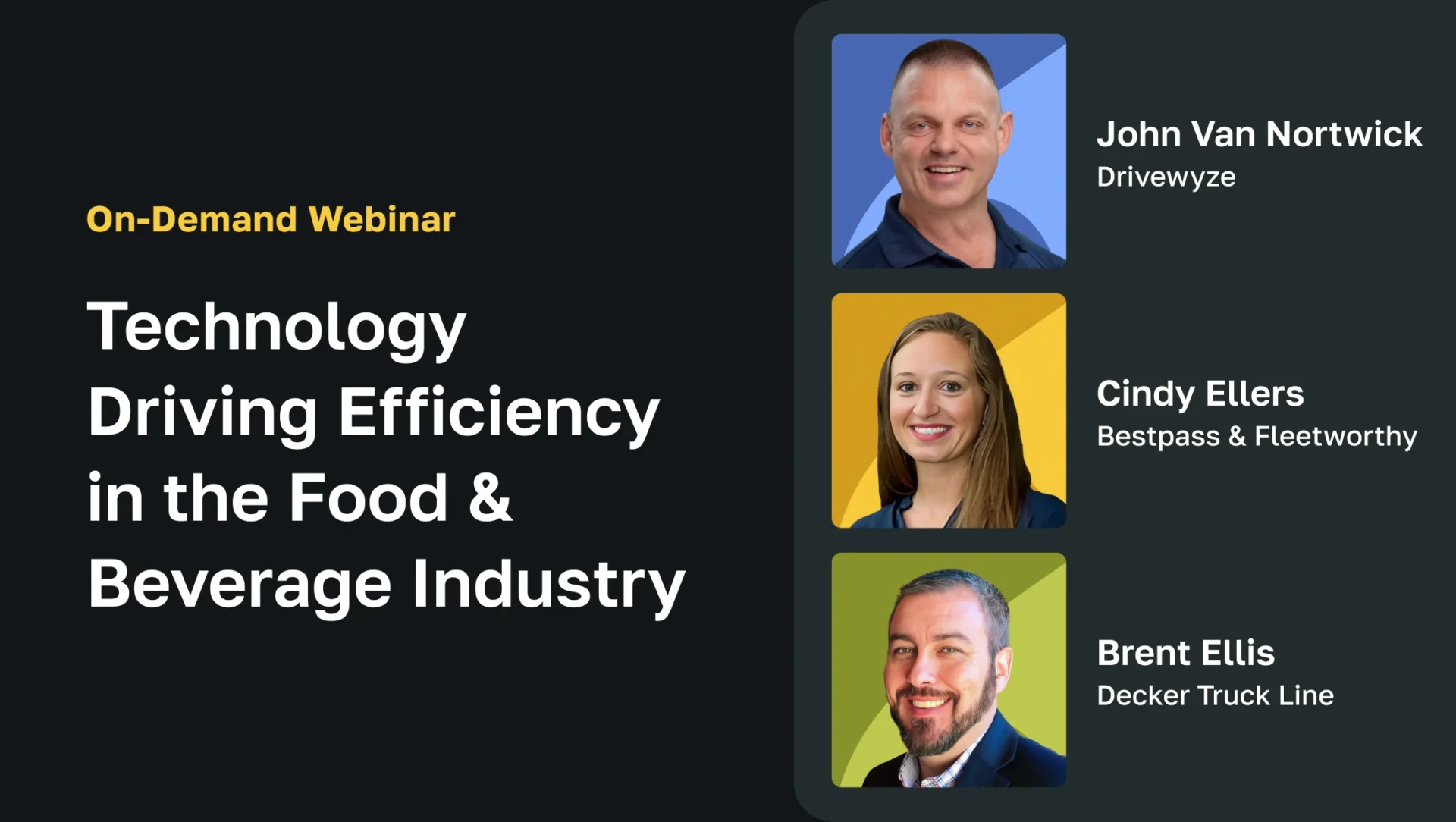
Uh, today I’m gonna be joined
by Brett Ellis from Decker Truck Lines, as well
as Cindy Ellis from Bestpass.
And I’m John Van Norwick, sales Director
for Safety Solutions from Drivewise.
And we’re gonna talk about a little bit about
Drivewise At Best Pass.
Have a little fireside chat with, uh,
Brent from Decker Truck Line
and talk about a little case study.
And then we will take questions from the audience.
So a little bit about Drivewise that I, I think our,
our vision is amazing, safe
and efficient commercial vehicle transportation system
with zero crashes and zero fatalities.
Um, it’s a lofty goal,
but we, we do do everything we can to, uh,
to help the industry move in that direction.
So, uh, a little more about our services.
Um, we are the largest
and com most complete waste station bypass coverage
with the largest vehicle to infrastructure
slash connected truck platform in North America.
Um, it’s fully integrated to your existing cab ld,
which makes for very effective alerts as well
as easy implementation.
And then we have some additional safety services
and Drivewise free that we make available to the industry
for no additional cost.
All of our services work the same way.
It’s essentially a, a Geo Feds platform
where we’re looking at, for the bypass.
We look two miles ahead, give the driver a warning
that he needs to move over
and wait for instructions on the bypass.
And then we’ll let him know if he’s cleared due,
bypass the away station order, if he needs
to pull in for whatever reason.
And our safety alerts work in a similar fashion.
So we provide a, an alert for the driver,
and then depending on the type of alert, once they move into
that wrist fence, we’re tracking their speed
and seeing the behavior of the driver as he moves through
that, uh, alert zone.
Uh, so a lot of great alerts and,
and the things that add to the efficiency of the food
and beverage transportation side of the trucking, as well
as Arrested Trucking.
Now, Cindy, I’ll take over for the Bestpass side.
Yes, thanks, John. Um, so Bestpass has,
has been around for quite a while.
We were founded 22 years ago
to help really level the playing field, uh,
by pooling toll volume of a lot of fleets.
It allowed smaller fleets to benefit from volume discounts,
which drove a lot of cost savings.
Uh, since then, we’ve expanded to simplify
what has become increasingly complex, uh, the system
of toll roads that require separate accounts,
different devices, separate bills, uh,
and now we support over 15,000 fleet customers
around 2 million vehicles and run over $1.5 billion in toll.
So, um, we’ve expanded quite a lot.
Our integrations and partnerships
with tooling authorities allow our customers
to seamlessly travel on toll roads,
which are often gonna be the most direct and safest route.
So that really helps support cost effective on-time
delivery, uh, critical in refrigerated transport especially.
Um, while the focus
of today’s webinars on the tolling component, uh,
understanding unpaid toll can lead to de delays
or suspensions in registrations and other issues.
We’ve recently expanded our solution set to include asset
and driver compliance, uh,
by joining forces with fleet worthy.
Our core focus is really
to help our customers eliminate the distraction
and administrative burden of toll, uh,
all while providing best in class customer
service for any customer.
Uh, any questions that come up along the way.
Uh, so we provide nationwide coverage with a single device
and one platform to allow for insights and,
and toll really to become a competitive advantage
for our fleet customers.
So without further ado, uh, I will introduce Brent Ellis,
uh, VP of business systems
and processes at Decker, uh, who has many years
of experience in transportation
and has driven a lot of really impactful innovation
that’s improved efficiency since, since joining.
Decker. Over to you.
Hey, Cindy, how are you? Doing? Great.
Um, why don’t you tell us just a little bit about, uh,
Decker and your fleet, uh,
and then we can jump into Fireside chat
and ask you some questions.
Sure. We’re, um, as the slide shows,
we were founded in 1931, uh, family owned company.
Um, just within the last roughly a year, uh,
we’ve moved into the, the third generation
of ownership within the family.
Um, we’ve, uh, the last four years we’ve, we’ve spent,
uh, looking at process automation and,
and ways to, um, uh,
create efficiencies within the operation.
Uh, I think we’ve made some, some good strides there.
Um, we’re about 750 trucks,
roughly 70% reefer, 30% flatbed.
Uh, we do cover the, uh, the lower 48.
Um, and, uh, everybody is,
is experiencing the same market right now.
So, you know, we’re, uh, we are right there
with everybody else in that, but, uh,
but we’ve made some, made some good accomplishments,
I think in the last, uh, last three and a half, four years,
and, uh, still have a lot of things in the hopper
and a lot of, a lot of changes coming.
So, uh, looking forward to what comes next.
Excellent. So we will just ask you a few questions
and, uh, Cindy, jump in when you, uh, when you want to,
but, uh, and I know there’s a lot of ’em,
but some of the challenges and that are unique to food
and beverage hauling compared to the other
areas in trucking.
What, uh, what can you help us understand
some of those different challenges?
Yeah, sure. The, uh, obviously one
of the biggest things is, is, uh, temperature control, uh,
or management of that, uh, keeping tabs on, you know,
a particular load or any number of loads at a given time
to be sure that they’re within their, uh,
temperature constraints.
Um, you know, it’s, it’s kinda odd to say it,
but, uh, making sure the reefer units have fuel.
Um, you know, it’s, uh,
traffic is worse than it’s ever been.
Our our highway systems are more populated
and more crowded than ever.
Um, construction, uh, you know, any
of those things can cause huge delays.
And if a, if a reefer unit runs out fuel, um,
there’s always the possibility that you just bought a,
a load of whatever it is.
So temperature management is definitely one of the,
one of the biggest challenges.
And I know we talked about, uh, washout as being a,
another element that’s
Washout is another one, depending on, you know,
we have a lot of, a lot of shippers,
and I’m sure everybody in that, that piece
of the industry does a lot of shippers
who have their own washout facility.
Um, so those are, are fairly easy to deal with,
but when a shipper doesn’t have a wash facility,
but they, they require one
before a, a load gets picked up, that
that too presents challenges
because you’re, you’re trying to juggle, uh,
fuel optimization and,
and obviously all the fuel savings you can.
Um, but then you may have to run a driver outer route, uh,
to get to a, a wash location.
Um, you know, that can affect on time pickup
because, uh, you know,
not all these wash locations are 24 hours.
So you can also, uh, you know,
you can also stump your toe on that pretty easy.
And, you know, if a driver, uh, arrives at a wash facility
after they’ve closed, you’re either sending him further
outer route or he’s waiting, you know, until they reopen or,
or whatever the case may be to get washed out.
So that’s definitely a challenge.
Right. That seems like a another
extra headache for you guys.
What kind of technology have you employed to deploy to, uh,
address some of those challenges?
So for our, um, for, um, temperature management,
we have some modifications to our, our TMS.
We use McLeod software,
and we have some modifications there that, uh, uh,
when a, when a shipper tenders a load via EDI, uh,
if the temperature information is there, we pull
that into the, the load information.
Um, if not, it’s, it’s kind of a, a different situation.
We have the driver call in, uh,
and send a copy of the BOL to verify temperature, uh,
and the information’s added
to the load within the system at that time.
Um, using our trailer tracking, um, we monitor the,
the box temperature, uh, that comes back, uh,
validates against the load information to see
that it’s within, within the constraints, uh,
and that the settings are all correct, the intel is set
and everything is is correct.
Um, if it’s not, if there’s any, any variance to that,
it’s outside of a range.
Uh, then that turns red on the driver management screen,
which is the, the one screen
where a fleet manager sees all their drivers
and all their loads at the same time.
Um, so that red draws attention to that.
Uh, we do have quite a few shippers
who don’t send commodity information
or temperature information in the tender.
So that’s why we have the, the driver call to verify
what the, what the BOL actually says.
And, um, you know, once we’ve done that
and updated the, uh, the information in the, in the system,
that prevents the whole screen from being read, which,
you know, for the, for the fleet management.
But, uh, we’ve, uh, we’ve got a couple other things
that we’ve done, um, nowhere near as, as impactful
as the, um, as the modifications to the TMS.
But, um, that’s our biggest thing really, is in being able
to monitor that is as having the, uh, uh,
the temperature information
and trailer tracking validate against the load in the TMS,
the load information to see, that’s correct.
If that warning to the site manager
that they’ve got a problem.
Mm-Hmm. How long does it take to preset out the temperature
that per degree, per hour set.
And what was the que I’m sorry, John, I, I didn’t catch.
How long does it take to preset the
temperature in the, in the trailer?
Is it, if you
Need, oh, the, the actual preset itself is,
is just a matter of, of changing the setting on the unit,
just like changing the thermostat in your house.
It doesn’t take long. Now, of course, ambient temperature
outside can, can have an effect on that.
Um, but usually it’s, they’re fairly quick to, uh,
to cool down to the, the temperature they need to be
or to warm back up if that’s the case.
Um, so it’s not, it varies depending on a lot of factors,
but it’s not, uh, not a, a huge amount of time.
Cool. Uh, in terms of on-time delivery challenges
that are common to other large trucking industry, uh,
trucking completes such as congestion
and weather, what kinds of technology are you deploying
for those challenges?
So we use, uh, we use a fuel optimization program that,
uh, it takes into account tolls and,
and, uh, speaking of tolls, uh, Cindy,
but we, uh, we take into account tolls, um, driver’s hours
of service, uh, numerous factors, uh, even
to an extent the, uh, uh,
the average wait time at a particular fuel stop, um,
to route a driver in the, the correct path to get fuel
and save as much as possible while still being efficient.
Obviously traffic, uh, construction,
anything else can have a, have an effect on that?
Weather, uh, is a big one.
Um, we do see some shippers, um, in the,
in the winter months, they’ll slow down production at one
facility and increase in another,
or maybe split up some orders to, uh, uh,
to reduce the length of haul, uh, for those, those orders so
that, uh, you know, it’s weather doesn’t affect it as much.
Uh, you know, for example, if they’re,
if they’re normally shipping out of the, out of the west
where there’s, uh, you know, uh, uh, a lot of weather, uh,
adverse conditions, then they may move that if,
if the loads go into the south,
they may ship from the south to the south.
Um, it becomes more of a regional game at times.
Um, but overall, um, you know, we’re subject to traffic
and everything else, just like everyone else is.
Uh, the big thing is kind of keeping tabs on that
and being able to monitor it
and alert the driver ahead of time that, you know, to,
to help them avoid that.
If not, you’re on the phone with the, with the shipper
or the consignee explaining why
you’re not gonna be there on time.
But, uh, and in a lot of cases, you know, uh,
we haul fresh meat as well, that’s,
it’s not prepackaged and it is never frozen.
So, um, at that point it, you know,
it’s a time sensitive load, so, uh, you have to kind
of play on those routes a little more carefully to be sure
that, you know, on time delivery is possible.
But by
and large, we have about a, a 98% on time delivery rate.
So, um, I don’t know if we’re lucky if we’re just
that good either way.
We, uh, we manage to make it happen most of the time.
That seems like you’re running a tight
ship over there, Brent.
It’s, um, it’s, it’s pretty, uh,
it gets pretty intense on the planning floor at time.
Yeah. So I know that’s exciting. Go ahead.
Sorry, John, I know John, uh, mentioned, you know, and,
and we’ve talked about delays, uh, not being ideal,
especially when you’re transporting things like,
like fresh meat or, or poultry,
but, um, weather traffic out of, out of your control.
But in terms of things that are under your control,
what are some, you’ve done some neat things
to integrate technology to, to really be pretty efficient.
Um, can you share some of that?
Yeah, one of the, one of the biggest things we did was,
um, uh, drive wise, uh, way station bypass,
and of course Bestpass for tolls.
Um, but, um, you know, with weigh station bypass, um,
we are able to, the driver gets a notification two miles out
when they’re approaching a weigh station.
Um, you know, it’s, it’s bad enough to have to stop.
If that driver gets, gets pulled in,
there’s nothing we can do about that.
But there, you know, you take a five, six lane highway and,
and maybe that driver’s in the third lane over
and they’re passing a truck,
or a truck is passing them on the right
and they don’t see that sign that says way station ahead.
Um, you can almost guarantee a stop,
but it is, it’s gonna take a lot longer than it would
to drive through the scales if he passes them.
So the weigh station bypass, giving the alert two miles out
and one mile out, and, uh, you know, notifying the driver
before they even really have to start the process
of slowing down and,
and pulling into the way station, whether
or not they can pass, uh, that’s huge.
That’s a huge time savings.
Um, you know, there’s the fuel optimization
as I mentioned earlier, that, uh, that helps tremendously.
Um, and of course, toll routes, um, you know,
the fuel optimization takes that into account
and determines, uh, based on fuel pricing.
Uh, sometimes it’s more economical to pay a higher toll
because fuel is, is less expensive there,
but there are times when, uh,
depending on the fuel variance on the toll route versus the
non toll route, it’s, it’s more advantageous to take the,
uh, the non toll route
and pay a higher fuel cost than to pay the toll.
So it, it takes all that, that into account as well.
Um, but, uh, you know,
you still run into those snags where there’s,
it’s just an unavoidable situations out
of everyone’s control, and there’s really no way to,
no way to minimize it.
So you just have to take the, take the beating and move on.
But, uh, you know, trying to keep the drivers, uh, aware
of their, their, their clock and how much time they have
and planning accordingly, you know,
looking at the available hours
before we assign a load to a driver,
and then the fleet managers making sure
that they make full use of their clock.
That’s, that’s huge. And of course, parking is a,
is a big thing for everyone now, when,
when a driver does have to take a break, you know,
there are times when they may have to go 10,
15 miles outta route to find a place to park, um,
or jump from one lot to the next to, to try and find a spot.
So, um, it’s, uh,
it’s become quite a challenge in the last several years.
Yeah. I always feel awful when I see those trucks coming
out of the rest area, exits on the side of the road.
It’s just, yeah, that’s, yeah, something’s gotta change.
Uh, this could be a tough question,
but you’re considered a bit ahead of the curve when it comes
to evaluating, sourcing,
and even building your own tech solutions.
So just kind of curious how you do that.
What’s your process?
So I have a, I have a team of five.
Um, they’re, um, they’re all remote.
They’re scattered from, from Alabama to, um, to Colorado.
Um, and they are without a doubt, um,
the most capable group of people I think I’ve ever worked
with, uh, when it comes to building our own stuff.
Um, and they all hate to see my name show up on their,
on their screen when I’m calling ’em.
’cause the, the words they dread worst
or, Hey, I got an idea.
Um, but we’ll, we’ll chase a rabbit quite a ways to, um,
you know, to find a way to, to make something more efficient
or automate something.
And, and automation, you know, a lot of people, um, tend
to think automation is a way to reduce head count,
but that’s not how we look at it.
What we look at is, uh,
where can we reduce the possibility of human error?
We’re all capable of, you know, fat fingering something
or, uh, overlooking something.
And if, if we can use the system
and use technology to, uh, uh, to overcome that, then
that just makes us even more efficient.
Um, as far as implementing new technology
that we don’t develop, uh, between the conferences that I,
I attend and, um, you know, having been in the industry
as long as I have, I I have a lot of contacts
and know a lot of people and know I’ll have people reach out
on a regular basis, uh, you know, to,
to show me something new or tell me about something
and we’ll dig into it.
Um, you know, in the last several years, uh, we’ve seen, uh,
a huge uptick in the number of startups
in the transportation technology space.
And, you know, I mean, let’s face it, in a lot
of cases those companies are set up to,
they’re built to sell.
Uh, they have an idea, they,
they put the framework together,
it may be 80% of the solution.
Uh, they wanna get enough market share that one
of the larger providers will purchase that company
and, you know, they buy their own island or,
or whatever the case may be.
But, uh, you know, the, the biggest thing is, um,
to, to evaluate.
When I, when I’m looking at,
at new technology in a new vendor,
um, I don’t look for a vendor.
I look for a partner, um, which both Drivewise
and Best Bestpass have been since the inception,
where we can bounce ideas off of each other.
Uh, we can look at new possibilities.
Um, you know, if I have an issue, I can go to them
and say, Hey, this is, this is a problem.
We have that, you know, what, what can we do to solve this?
Is there anything possible?
And, uh, the biggest, you know, one of the biggest things
with all the startups that have been out there is I try not
to put all my eggs in one basket.
And I, I don’t want to, you don’t want to
rely too heavily on a, on a really young company, uh,
because, you know, if they don’t get that market share,
they’re probably not gonna be around long.
And, and the other thing is, if they do get the market share
and they get, uh, swallowed up by a larger entity, is it,
is it an entity you wanna deal
with, you know, down the road?
So, uh, um, you have
to be really careful in vetting new technology.
But overall, we do pretty well there.
We’ve only had, uh, in the last four
and a half years, we’ve had one situation where, you know,
we, we probably shouldn’t have gone over the route
that we did, but, uh, we were able
to do some development on our end
and basically replicate what we had.
So, um, overall we do pretty well there.
Cindy and I both think you do a great job
of selecting technology partners, so,
Well, I’m, I’m, there are at least two
that I’m really proud we made, we made the move.
So,
And I know you do a lot of things for the driver,
and I think Drivewise and Bestpass are a part of that.
Uh, you mentioned something earlier
and I thought that was really cool.
They, the fact that a lot of your drivers recently have come
as referrals from your existing drivers, which think
that’s a test estimate to your,
what you’re doing for your drivers.
That I think that speaks volumes when, uh,
when dri current drivers will refer other drivers, uh,
and people they’ve known, you know, maybe they’ve worked
with ’em in the past or, uh, you know, friends
and that sort of thing when they’ll, when they’ll recommend
a company to a friend
or to a coworker, that,
that says a lot about the programs
you have in place for the driver.
Uh, you know, it’s funny, when we, when we first switched
to Drivewise, um, from our previous provider,
drivers were not thrilled about the change.
Um, you know, they were kind of ingrained in
how they do things, and they were used to looking for
that transponder and that tiny
green light on the windshield.
And, um, you know, when we announced
that we were making the switch, oh, they were wailing
and gnashing of teeth and, uh,
but it, it took a all of about two weeks
and that completely quieted down.
And, and now, uh, you know, we occasionally have a driver
who has a login issue or something on their, on their tablet
and, uh, maybe they haven’t logged in correctly
and their account didn’t sync.
So, uh, you know, as soon as they realize it’s, you know,
maybe drive wise is not working, man,
they’re on the phone immediately to let us know.
They, they really, really love it.
And it’s, uh, they’ll all tell you
that it’s far better than, than what we’ve had in the past.
So That’s great.
That says a lot is, well, if a driver brags on something
that’s, that’s really a compliment
because they can usually find
the negative in about anything.
Yeah. So I know Because I was one at one time, so
It’s very refreshing to be part of a technology
where the drivers actually want your service in the cab.
So it’s a nice change.
I know, um, the weather’s big deal for everybody,
but how does it play a part in your, your delivery and,
and your thought process as far as food and beverage?
Well, like, like I mentioned
before, especially with the time sensitive freight, um,
you know, that’s a, that’s a big issue, uh,
whether it can be, and,
and those shippers that do go to more of a regional
distribution model during, during the winter months,
that’s, that’s helpful.
Um, the, you know, one
of the biggest things is when there’s, uh,
especially winter weather, you know, you wanna,
you wanna be extra sure that the, uh, the, uh,
anti gel is in the fuel tanks
and that the, uh, reefer tanks stay full.
Uh, ’cause the last thing you want is a, you know, is a load
of product on the side of the road with a,
a reefer unit that’s down.
Um, and we have, you know,
several alarms even on fuel levels to keep us, keep us aware
of that if there is an issue.
Um, and we have a, a program in place, the fuel optimization
that we use doesn’t take into account the reefer fuel,
but, uh, uh, we have some guidelines for the drivers on
as far as when to, uh, when to fuel the reefer.
Um, and they, they do a really good job with that.
So that’s not anything we see on a regular basis.
There’s, you know, there’s an occasional slip,
but it is, it’s few and far between.
I’ve probably seen that happen twice in the last
four or four and a half years.
And it, it didn’t create an issue, you know,
the driver was 10 miles from a fuel stop, so not a lot, not,
not a lot would change in that distance.
So, um, but it can be, uh, it can be catastrophic,
you know, if they don’t, if they don’t stay on top of it.
Is
There anything else from the compliance
side of efficiency?
Um, safety or prepared permitting?
You know, really hours of service is the biggest thing.
Just making sure that the fleet managers are helping the
drivers manage the clock, uh, just to be sure that they’re,
uh, you know, we wanna squeeze every, every hour we can out
of that, uh, out of that driver’s clock,
especially on the time sensitive freight.
Um, but overall the drivers do a really good job.
Um, you know, they will, they will do their best
to get every, every mile in that they can.
And like I said, with, you know, roughly 98% OTD, that’s,
uh, uh, in my mind that’s quite an accomplishment in the,
in the, the trucking world today.
Reefer, flatbed van, doesn’t matter what it is.
If you can do 98% on the time, that’s, that’s pretty strong.
So yeah, they do a really great job at that.
So do your drivers take advantage of the sleep
of birth very often, or do you encourage that
or do anything special related to that specific,
The split sleeper?
Yeah. Yeah, they, uh, we have a few that, uh, uh,
especially those that, that have a longer length of haul,
you know, on a longer run, they’ll,
they’ll split the sleeper.
Um, by
and large, it’s not something we see
that often just on those, those longer hauls, you know,
maybe from, uh,
we may have something going outta coming outta Chicago
and going all the way to the West coast.
We’ll we’ll see ’em use that a, a time or two on the trip.
Um, so it’s, um, it’s not an everyday,
it probably is an everyday occurrence.
It’s just not a large percentage of the fleet that, right.
They use it by
and large, they can get done what they need
to do within the, you know,
within the standard standard clock. So
Just taking the normal break mm-Hmm.
So what’s changed with f and B in the past five years?
And maybe what do you predict will
happen in the next five to 10?
You know, in the last five, the, the last two have two
and a half have really been the, the biggest we’ve seen, uh,
you know, with, with obviously meat prices continuing to,
to, uh, skyrocket, we’ve seen, uh, there’s still plenty
of capacity there, but we’ve seen a reduction in, uh,
in actual freight, uh, just
because I’m sure sales are down for the,
for the meat producers.
Um, and then, uh, you know, we’ve seen the introduction
of some, some synthetic
or artificial proteins, um, that, uh,
that’s, that’s definitely, uh, had an impact.
Uh, ’cause you know, some of
that doesn’t have to be refrigerated.
Uh, so I think in the next, in the next five years,
we’re gonna see a, a bigger shift to that, especially if,
if, uh, meat prices continue to to go up,
we’re probably gonna see a bigger reduction.
Um, and as in place of that,
we’re gonna see more artificial protein.
I know that, you know, a lot of the, uh, a lot
of the producers are, they already have several solutions,
but they’re adding more all the time.
So I think that’s gonna grow as well.
Um, I think as the, um, uh,
the market continues to, to, or not the market necessarily,
but the, uh, demand continues to grow,
I think we’re gonna see, um, even more,
uh, capacity shift.
Uh, I think honestly that the,
the reefer section will probably, uh,
there’ll be a big reduction in that over the next few years,
I think, uh, just
because of things like the artificial protein
and uh, obviously meat prices, just like anything else,
you know, if a, if a family of five decides that they can,
you know, they can get by without purchasing as much meat,
even during an economic, uh, situation like we’re in now,
you know, you kinda get conditioned to that
and they may not never go back to, um,
their normal buying habits.
So, uh, it’s gonna be interesting how it shakes out,
but, uh, I think there’s,
I think we’re gonna see a reduction in the,
in the refrigerated side over the next five years or so.
Um, it’d be interesting to see how it turns out.
Alright. Cindy, you have any other questions or?
I don’t think so. I think, I think we’re ready for, uh,
case studies and audience q and a.
Alright, let’s do a quick case study.
I’ll go through little case
study that we did with company that, uh, 33,
this is in one month, this case study
that their operating cost save $33,000,
really up to twice as many loads per day
and 810 waste station bypass
with a huge emission reduction.
So in, in just one month with, um,
127 truck Fleet Cumberland Farms, it’s,
uh, there’s a lot of savings.
And like Brent was talking about just efficiency and,
and keeping that, uh, on time delivery.
I think all the things that they employ,
deploy are part of that.
And it’s another good case study that supports that process.
And then one of the things I like about it,
and we talked about this, was that it’s, uh, it’s,
the drivers like it and it’s sufficient for the fleet.
So, uh, you know, like Tim Stoic says Drivewise is a win-win
for both the company and drivers.
And I think, like Brent was talking about, I think it just
happy drivers are safe drivers, they’re efficient drivers,
and it just builds on each other, on each other.
So, um, I think
Drivewise the best pass are a good combination that kind
of supports all the other things that Brent
and Decker are trying to accomplish
and some of these other foods.
So excited to be a part of, part of the process.
And if we had any questions from the audience, anything
for Brent or Cindy
or myself, love to hear your questions.
As far as fleet planning, Brent, does it,
do you incorporate the, the tolling information into that
for their routes and their trip plan?
Is that built in
To an extent?
Uh, from a manual perspective, no.
But, um, as I mentioned
before, the the fuel optimization program that we use
calculates toll information into that.
Um, and it’s, you know,
it even looks at the costs on both the toll route
and the non toll route to determine, you know,
if we’re better off to, uh, take the non toll route
and pay a little more for fuel.
’cause typically fuel is higher on the non, on toll route.
Um, but from that, from that perspective, we do,
but outside of that, we don’t do a lot manually to, uh,
you know, to, to take that into account.
Excellent. So as you’ve made a lot of changes to the,
the tech stack, um, obviously, you know, taking on Bestpass
and, and Drivewise, I think both, uh, back in, in 2021, um,
what kind of impact have you seen?
Like, did, did you,
did you see a direct impact on things like on time delivery
with, with more way stations bypassed and,
and less, you know,
more direct integrations on the, the tolling side?
We did, um, we saw an increase of roughly, uh,
in the first few months, um, about one and a half to 2%.
And that doesn’t sound like much,
but you know, at, at that time when we, uh,
when we first implemented, uh, you know, we were moving
roughly 3000, sometimes over 3000 loads a week.
Um, so, you know, when you’re looking at 30 loads, 30
to 45 loads a week, um, you know, a a gain
in on time delivery, uh,
and you look at that over a month, that’s a,
that’s a pretty big, uh,
pretty big increase when you’re already doing fairly well,
um, as far as on time delivery.
But, uh, you know,
the bigger thing is just driver satisfaction.
Um, again, as, as, uh, John mentioned, you know,
happy drivers, um,
have good cheese comes from happy cows, right?
So, uh, you know, if you keep your drivers happy,
they’re gonna, they’re gonna do a better job.
Um, and not having to, uh, uh, you know, not having to stop
for the, the way stations
and, uh, not having
to worry about tolls and that sort of thing.
It’s, it’s a, it, it makes a big impact.
And, um, you know, for toll management from a,
from a back office perspective, you know, the driver had,
doesn’t have to do a lot with that.
But from a back office perspective, uh,
just the time savings and not having to,
to handle those disputes when they come up
and, uh, you know, the outside, um, uh,
for example, you got a, a plate reader
at a scale in Colorado that, uh, you know, it doesn’t,
it doesn’t grab that front plate for whatever reason,
but it catches the, the one on the back.
Well, then you’ve got an invoice, um, you know,
that doesn’t go to the, necessarily go to the toll provider
because it didn’t read the transponder.
So, uh,
but, you know, uh, Bestpass has allowed us, we’ve,
we’ve used the API and,
and built our own integration, uh, for both tractors
and trailers, um, so
that our equipment is always up to date.
The transponder are always up to date,
and, uh, we see very few,
there’s the occasional one-off invoice, but it’s not often.
Um, and of course, Bestpass handles all the disputes for us,
so we don’t have to, you know,
we don’t have to deal with that.
Um, we get the, uh, the benefit of the,
the discount programs that, that Bestpass has
with toll providers, and that’s huge.
Um, you know, Drivewise has the, the notifications
for everything from parking to rollover zones, you know,
the, I forgot how many, John,
you can probably refresh my memory on that,
but how many, uh, hazards are, are
geofenced across the, the nation, um, you know,
drivers get notified of those
and there’s a driver will never tell you, you know, oh man,
I could’ve been in a bad spot.
But at the end of the day, I’m quite sure there are, that
that’s a high number, uh,
because we have a lot of new drivers, you know,
coming into the, into the industry.
Uh, they don’t have that 30 years of experience
and they haven’t been all over the country.
And, uh, you know, things will, things will catch you
by surprise out on the road.
And, uh, being notified of those ahead of time, uh, is huge.
And that’s, uh, that’s definitely a benefit.
And anybody who’s ever been in a truck
or around one knows
that they are far more efficient on their
wheels than on their side.
So, uh, it’s, uh, it’s a big, it’s a big impact,
the, the notifications and all.
So it’s been a, it is, is been a fantastic partnership
to this point, and I have no doubt
that it would continue to be. So
Yeah, dry wise, free is, uh, I think a great
contributor to the industry.
And, you know, the other, the state agencies
that feed us a lot of that information there,
they won’t partner with us if they, if it doesn’t work.
So they put us through a pretty good testing
process to make sure.
So do you have a couple questions? Go ahead. Oh,
Go ahead. I’m sorry.
I got a couple questions, so I just thought
I’d run it by you.
Um, you know, staying on tech, on top
of tech was something we talked about.
Do you have any recommendations for managers to stay on top
of that if they can’t afford a team of five like you have,
or if they’re, you know, maybe a smaller fleet
and they’ve got some challenges to that areas?
You know, I would say, um, the vendors you currently work
with, uh, when you have problems, go
to those vendors and, and ask them.
They may have done a one-off custom solution for some,
you know, some other customer of theirs that,
that fits your need.
Um, you know, most of the vendors out there now are,
are pretty willing to work with a, with a fleet to get, uh,
you know, to solve an issue for ’em.
Uh, because as I mentioned earlier, there’s been a,
a huge influx of, of smaller companies
and startups in the last few years,
and that’s created some, some pressure on some
of the bigger, bigger vendors.
So, um, you know,
those smaller companies are typically more, uh, more open
to working with a customer to solve an issue,
but, uh, they’ve kind of forced the,
the larger providers to do the same.
Uh, in addition, you know, there are a lot of, um,
there are a lot of third party, uh,
developers out there now, development companies that will,
and I’ve done that a time
or two where we just didn’t have the time.
We had a, you know, our plate was full
and we didn’t have time to, to dig into a project
and I’ll, I’ll find a third party that, uh, you know,
they’re willing to take it on and, and work with them,
and we qa it in the end.
Um, and you can do that fairly cost effectively.
Um, you know, it’s, uh, there are a lot
of solutions out there now.
Uh, the biggest thing is just, uh, you know, stand on top
of, of new providers
and, uh, attend the conferences, uh, spend some time.
I tend to spend more time in the, in the,
on the trade show floor than I do in the, in the sessions,
in the meetings, um, when I go to a conference just
because I wanna see what’s new
and, you know, there’s, there’s always something new, so.
Great.
Another question was, uh, you could give advice to a fleet
that wants to get into the food
and beverage hauling anything,
any mistakes they should avoid or suggestions?
The number one thing I think is the,
the two top things are, uh, maintenance.
You know, keeping the, keeping the reefers in good shape,
keeping those, uh, serviced.
So, you know, to, to minimize the issues
and trailer tracking
and in, uh, integration with the software that you use.
Those are the two biggest things, I think.
Um, being able to, you know, go to sleep at night knowing
that, that the reefers are maintained
and not, you know, they’re not apt
to just die on the side of the road.
And knowing that you have a way to monitor that
and be sure that it’s, you know,
it’s at the temperature it should be.
Um, outside of that, you know,
around when you get away from,
when you take the temperature control part
and the monitoring out of it, at the end of the day,
it’s just trucking, you know, it’s, it just is what it is.
Um, but the,
the temperature piece does create a huge challenge.
So, um, having a way to monitor that
and knowing that, you know, your fleet is as is, as up
to date with software updates in the units and,
and just general maintenance.
Um, and of course make sure they have fuel in ’em.
Those, those are the, the biggest things.
Yeah, it’s definitely an exciting time.
There’s all the technologies that’s available
and everybody’s got their APIs, so like you were saying,
third party developers could probably pull in some data
and provide solutions for you custom. So yeah,
They absolutely Can. Opportunities
and talking to your partners like Drivewise
and Bestpass, you know, we work with Bestpass,
so if somebody, one of our customers talks to us
and has a question that we can solve it with Bestpass
and different technology,
we obviously we get the experience.
So I think it’s a great advice to talk
to your current partners and see
what solutions they know about
that their other customers are doing.
And then of course, the trade shows are great
resource. Um, I think there
Are probably a couple of people at both Drivewise
and Bestpass that hate to see my name pop up as well,
because I’m, I’m usually, usually my first question is,
or my, the first thing I say is, Hey, I got an idea.
So I’m pretty sure both of you guys have have some people
that are not thrilled at seeing my name come up. So
We love it, we love the feedback, um, on both sides.
I’m, I’m sure not to speak for, for John,
but, uh, we,
we love having customers like you to, to partner with.
It keeps us on our toes, keeps us ahead of trends,
so keep ’em coming. Brent.
Yeah, I don’t think I’ve had any, remember you
Said that I just listened to the customers
and that they’ve always got the solutions.
So yes, we really appreciate you being on the, uh,
the webinar and, uh, and if you got any final thoughts,
Uh, I do see a couple of other questions.
So, uh, Brent audience wants to know, uh,
how are you preparing for the future
of autonomous vehicles potential
impact on food and beverage?
And I’ll ask the same on, on, uh, electric vehicles.
So what, how have,
how have you guys been preparing for that?
What are are any thoughts or experiences you have there?
So with the electric vehicles, um, you know, I think we,
we can all agree the infrastructure is just not
there to handle that yet.
And I think there’s a lot of bureaucratic red tape
that will have to be, um, cut
before that becomes a viable solution.
I think in a, uh, you know, a, a local fleet, uh, you know,
an LTL fleet, uh, a UPS
or a a FedEx package delivery, that sort of thing.
I think we’re almost there.
And I know they, they are both, uh, uh, both FedEx
and UPS are, are, you know,
they’ve converted parts of their fleet.
Uh, from an over the road perspective, I think we’re,
uh, we’re a little ways off.
Um, you know, the, it, how long did it take the government
to decide what the driver,
how many hours the driver could drive?
And now you wanna throw in what’s the distance
between charging stations and how far can they go?
Um, I think that’s gonna be a minute, um, from, uh, uh,
from an autonomous perspective, um, you know,
I think there are, there are places where that’s, uh, where
that’s a viable solution, that there are certain areas,
certain aspects of the industry.
But at the end of the day, um, you know,
when you take weather and all these things into account,
I think there’s, I think there’s a lot of reservation
around autonomous trucks, uh, to this point.
I know they’ve done a lot of testing
and, um, I worked for a carrier who had, at one point,
who had, uh, uh, we were, we were working with one
of the providers who was no longer in the space, um, to uh,
uh, kind of pioneer that.
And we had actually signed a contract to take 250 of those.
Um, maybe that was a blessing in disguise when the,
you know, when the, the provider wasn’t there anymore.
But, uh, at the end of the day, I think, I think both
of those we’re, we’re still, uh,
just from an infrastructure perspective,
I think we’re a little ways off from that.
As far as the future of, of reefer, you know, I’m,
as I mentioned earlier, I feel like
we’re gonna see the demand, uh,
decrease a bit in the, in the coming years.
But, you know, reefers are, are fairly versatile.
Um, you know, we, we tend to keep those, um,
usually 10 years or so before we turn ’em over.
Um, our tractor fleet, we turn over every three years,
but trailers are a little
different, a little different story.
But a a reefer is pretty versatile.
You know, you can’t put reefer freight in a van,
but you can put van freight in a reefer.
Um, so, you know, and,
and we do that on a regular basis with,
with back hauls and that sort of thing.
So, um, you can be a little more flexible,
uh, you know, to adapt to a,
a changing market when you have reefers.
And if, you know, if, if over the next
five years we determine that, that the,
the market is just not there, then you just downsize
that reefer fleet and you add some, some vans in.
Um, so you, you can be a lot more adaptive, uh,
from a reefer perspective if that market does change.
It is just hard to go from a, you know, you can’t, you just,
just can’t make a trailer cold enough if
it’s, if it’s a van.
So, um,
We’ve got another question related to Bestpass,
so I’ll ask that one is, what kind
of separates Bestpass made it a good solution?
Why’d you choose Bestpass?
So we have been with our, our previous provider for,
since the beginning of time.
Um, and they were, they were really attached
to our previous provider.
Um, but at the end of the day, um, you know, there’s,
um, the, the fact that they handled the disputes that it,
there was such a decrease in back office, the fact
that we can integrate directly
and not have to, to manually manage the transponders
and keep track of which ones in which vehicle and all that.
And we even have, uh, you know, now Bestpass has a, um,
a report out there that will show us if, uh, uh,
if a transponder was in an area that’s questionable.
You know, if for example, if a, a driver decides they’re,
they’re going on vacation, they decide they’re just gonna
take the transponder out of the truck
and put it in their car while they’re on vacation,
then you know, we can, we can catch that.
Um, and just the cooperation that we have,
that’s been the biggest thing.
Um, it’s,
and the discounted, you know,
the discounts from the providers is huge.
Uh, gives us, uh, in a way it’s kind
of like the buying power of Walmart, you know, versus, uh,
a smaller retail, uh,
because Bestpass has enough fleets under their,
under their umbrella that, you know,
they get a bigger discount and that’s passed on to us.
So that’s, that’s huge.
And the transition for us was seamless.
We, we kinda laid that out so that it, uh,
it coincided with, uh, new registrations and,
and, uh, uh, cab cards retractors.
So we gave a new, a new tag, a new registration,
and a new transponder all at the same time.
And, uh, you know, it was, it was a one touch deal
where every truck had to cycle through anyway.
We might as well change the transponder while they’re there.
So it was, it was really seamless for us.
And, uh, it’s been fantastic,
but the, the, the discounts are huge, so
that’s a definite plus.
Great. Alright.
I don’t know that I see any other questions.
So, um, you know, for,
if you wanna interested in Drivewise pretty clear
or free safety alerts, just uh, reach out
and you can book a demo with me and I can get started.
And Cindy, I’m sure we’ll do the same with Bestpass.
If you wanna get started, we can do a trial
and just appreciate everyone’s time.
Yes, thanks everyone for, for joining today
and, uh, a special thanks to, to Brent for joining,
uh, John and I today.
Yeah, it was great. Very informative.
Glad to do it.
Read Transcript
Watch this fireside chat exploring the challenges of food and beverage trucking, from navigating complex regulations to ensuring perishable goods’ freshness and safety. Discover insights from partnerships with Weigh Station Bypass (Formerly Drivewyze) and Bestpass, and explore a case study with Decker Truck Line. Don’t miss this opportunity to gain valuable industry knowledge!
FAQs
What will I learn from the “Technology Driving Efficiency in the Food & Beverage Industry” webinar?
You’ll hear how food and beverage fleets handle complex regulations while protecting perishable goods in transit. The session features insights from Weigh Station Bypass (Formerly Drivewyze) and Bestpass, plus a Decker Truck Line case study, with practical takeaways on weigh station bypass, toll management, in-cab safety alerts, and real-time driver messaging.
How does technology help food and beverage carriers navigate complex regulations while keeping perishable goods safe?
The webinar explains how tools like weigh station bypass, hazard-based safety alerts, and proactive driver messaging reduce delays and compliance risk, which protects time- and temperature-sensitive loads. Integrated workflows and partner solutions help carriers move faster through checkpoints and keep drivers informed of risks that could impact product quality.
How can weigh station bypass and safety alerts help a food and beverage fleet?
Weigh Station Bypass (Formerly Drivewyze) helps qualified trucks receive more bypass opportunities, cutting wait times at scale houses and supporting on-time delivery for refrigerated shipments. Its in-cab safety alerts notify drivers about hazards and high-risk areas so they can make safer, more informed decisions on the road.
What does Bestpass do for toll management, and why is it useful for F&B trucking operations?
Bestpass consolidates toll payments and invoicing across agencies into a single program, reducing administrative work and toll violations. For time-sensitive food and beverage routes, this means fewer surprises, cleaner records, and clearer visibility into route costs.
Do you have a case study on Decker Truck Line’s results using Weigh Station Bypass (Formerly Drivewyze), Bestpass, or Fleetworthy?
Yes. The webinar includes a case study with Decker Truck Line—watch the recording or select Read Transcript on this page to review the details discussed.
Steps to roll out weigh station bypass and in-cab safety alerts across a refrigerated fleet
Start with a pilot: confirm device compatibility, enroll select tractors with Weigh Station Bypass (Formerly Drivewyze), and define success metrics (bypass rate, alert engagement, delays avoided). Train drivers on alert meaning and SOPs, monitor early results, then expand fleetwide with ongoing reporting and coaching to maintain compliance and safety performance.
What are the top challenges in food and beverage trucking, and which technologies address them?
Key challenges include regulatory complexity, time-sensitive deliveries, and protecting perishable goods in varied road and weather conditions. The webinar highlights solutions such as Weigh Station Bypass (Formerly Drivewyze) for weigh station bypass and safety alerts, Bestpass for toll management, and real-time driver messaging and hazard-based alerts to keep drivers informed and on schedule.
Tools for real-time driver messaging and hazard-based alerts in the food and beverage industry
The webinar and related resources point to in-cab driver messaging and hazard-based alerting integrated with partner platforms like Weigh Station Bypass (Formerly Drivewyze). Look for tools that deliver context-aware alerts, confirmation/read receipts for coaching, and reporting that ties messages to outcomes like fewer delays and safer routing.
How can fleets ensure perishable goods’ freshness and safety during transport?
Minimize dwell and unexpected stops by using weigh station bypass, streamlined toll management, and proactive driver alerts. Standardize SOPs, provide timely in-cab communications, and plan routes that reduce risk and keep refrigerated loads moving within schedule.
Where can I watch or read the transcript of Fleetworthy’s webinar on F&B trucking efficiency?
Watch the 47‑minute recording on this page and select Read Transcript to review the full conversation. Both are available directly from the webinar resource without additional steps.