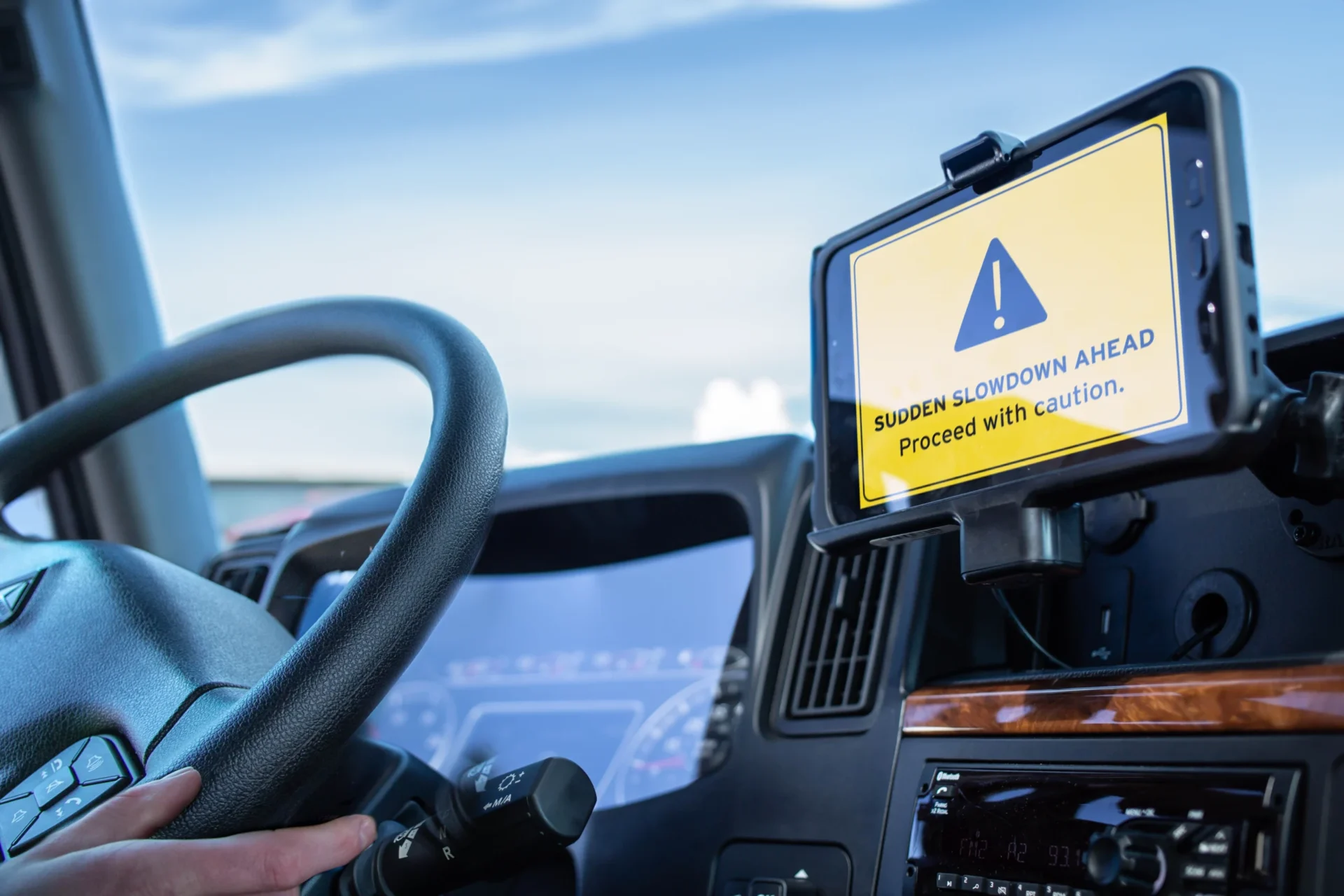
When congestion, sudden slowdowns, or roadway hazards appear without warning, drivers often have only moments to react. Traditionally, fleets have relied on roadside signs, CB chatter, or dispatch updates—tools that are often too delayed to meaningfully influence driver behavior.
For fleets that prioritize readiness, that delay is a serious problem. You can’t control when a hazard appears, but you can control how quickly your drivers know about it and how prepared they are to respond.
That’s why the industry is evolving. Proactive in-cab alerts have shown—through independent peer-reviewed research and statewide pilot programs—the ability to meaningfully change driver behavior within seconds, reducing crashes, delays, and risk across the board. They give fleets a practical way to control what they can in some of the most unpredictable driving environments.
Drivers Slow Down When They Receive In-Cab Alerts
Multiple studies now confirm what many fleets have come to believe: real-time in-cab alerts meaningfully change how drivers behave almost immediately.
Purdue University Study: Real-World Speed Reductions
A comprehensive analysis of 20,000+ in-cab alerts across 44 Indiana corridors found:
- 15% of trucks slowed by at least 5 mph within 30 seconds of receiving a congestion alert.
- 21% slowed by at least 5 mph within 30 seconds of receiving a Dangerous Slowdown alert.
These reductions are measured directly through vehicle telemetry—not surveys—making the behavioral impact objectively clear. The study also noted that drivers typically encountered congestion 2–3 minutes after receiving the alert, suggesting they were warned at precisely the right moment to make safe decisions.
Ohio DOT Statewide Study: Reinforcing the Findings
In a separate evaluation led by Ohio DOT and multiple universities, researchers found:
- Drivewyze alerts help drivers avoid stopped traffic and react more proactively to roadway changes.
- Drivers overwhelmingly view the alerts as helpful and effective in real-world conditions.
(Driver survey and behavioral analysis)
The study concluded that the Drivewyze system “may yield positive returns on safety and mobility,” validating the value of proactive alerts at scale.
Driver Feedback Mirrors the Data
In a recent driver survey conducted by Drivewyze, 89% of drivers say Sudden Slowdown alerts are effective and 51% call them “very effective”
Fleets that deploy in-cab technology know how important driver trust is when it comes to both adoption of technology and long-term satisfaction. Drivers trust in these alerts helps fleets drive consistent, predictable reactions during high-risk situations — one of the few controllables available in unpredictable traffic environments.
Proactive Alerts Don’t Just Change Behavior; They Reduce Crashes
Influencing driver’s speeds near critical areas is powerful on its own. But the downstream benefit is even more compelling: fewer crashes, fewer secondary incidents, and fewer hours lost to congestion.
Crash Reductions
Independent academic analysis and state DOT evaluations found:
- Up to 29% decrease in secondary crashes after Drivewyze alerts were implemented (Ohio data).
- Significant reductions in high-risk rear-end collisions where CMVs encounter stopped traffic.
(Ohio DOT congestion-related crash analysis)
Fewer Delays for Drivers and the Motoring Public
According to the Drivewyze Smart Roadways one-pager:
- Alerts helped eliminate over 20 hours of delay per mile of highway congestion.
And Ohio’s study estimated large travel-time savings from congestion-related crash prevention.
Want your drivers to receive earlier, more accurate hazard warnings? Discover how Safety Alerts help fleets reduce crashes, avoid sudden slowdowns, and keep drivers safer on every route.
Why In-Cab Alerts Work: The Science Behind the Impact
Across the three analyses, several themes explain why proactive alerts outperform traditional methods:
1. Alerts Arrive Earlier and More Precisely
Instead of spotting brake lights—or relying on roadside message signs—drivers get a warning as soon as probe data detects a slowdown ahead. Purdue’s study shows this window gives drivers 2–3 minutes to respond before reaching slow traffic—a critical safety margin.
2. Alerts Are Delivered Where Drivers Are Already Focused
Drivers don’t have to scan for signage or divide their attention. In-cab placement ensures the message reaches them in real time, with no external distractions.
3. Alerts Build Driver Trust Through Accuracy
Ohio surveys found drivers preferred Drivewyze alerts over traditional systems because of their relevance and timeliness.
Accuracy builds trust, and trusted alerts get paid attention to. That gives fleets more consistent, predictable driving responses — one of the few controllable safety factors on the open road.
The ROI of Proactive Alerts
Research and field data converge on a simple conclusion: investing in proactive in-cab alerts delivers measurable financial returns.
From Drivewyze program results:
- Prevention is profit—avoiding even one crash can save a fleet hundreds of thousands.
- Fleets report reduced at-fault crashes, improved driver behavior, and higher satisfaction.
From the Ohio benefit-cost analysis:
- Proactive alerts reduce crash-related costs, delays, and congestion for both fleets and the public.
For modern fleets, this technology is no longer a “nice to have”—it’s a reliability and safety multiplier.
A Safer Road Ahead with Fleetworthy
Drivewyze by Fleetworthy delivers proactive, real-time alerts through ELDs and in-cab devices—no extra hardware required.
As the research shows, these alerts help drivers:
- Identify hazards sooner
- Slow down more quickly
- Avoid secondary crashes
- Reduce congestion-related delays
- Build safer, more efficient driving habits
Backed by independent academic research, statewide DOT studies, and strong driver adoption, proactive in-cab alerts give fleets a practical way to control critical safety variables.
Combined with the broader readiness tools Fleetworthy provides across compliance management, toll, and weigh station bypass, these capabilities work together to reduce exposure, improve day-to-day predictability, and strengthen overall fleet readiness.
Ready to see how proactive alerts and bypass technology can strengthen your fleet’s safety and efficiency? Schedule a demo with Fleetworthy and experience the full platform in action.